
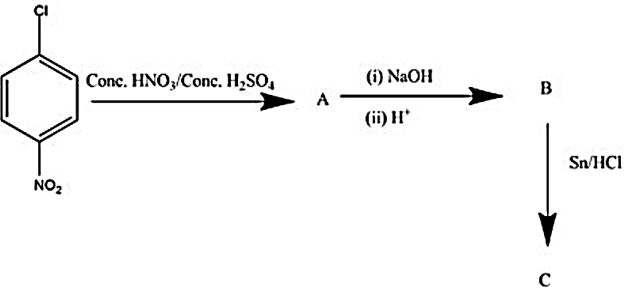
Identify A, B, and C in the following reaction:
Answer & explanation
Correct answer: option 2
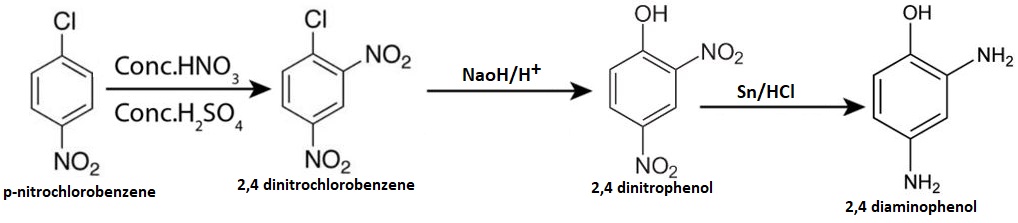
The correct answer is Option (2) → A: 2,4-dinitrochlorobenzene; B: 2,4-dinitrophenol; C: 2,4-diaminophenol
The starting compound is $\textbf{p-nitrochlorobenzene}$ (chlorine and nitro group in para position).
The reaction sequence involves:
$\textbf{Nitration}$ using conc. $HNO_3$ / conc. $H_2SO_4$
$\textbf{Nucleophilic substitution}$ using $NaOH$ followed by acidification
$\textbf{Reduction}$ using $Sn/HCl$
Step 1: Nitration
The molecule already contains:
$Cl$ (ortho/para directing)
$NO_2$ (meta directing)
Since the $\textbf{para position relative to Cl is already occupied}$, nitration occurs mainly at the $\textbf{ortho position to chlorine}$, which is also $\textbf{meta to the existing nitro group}$.
Thus the product formed is:
$\textbf{2,4-dinitrochlorobenzene}$
Therefore,
$\textbf{A = 2,4-dinitrochlorobenzene}$
Step 2: Reaction with NaOH
Aryl halides containing strong electron withdrawing groups (like $NO_2$) at ortho/para positions undergo nucleophilic aromatic substitution ($S_NAr$).
Here, $Cl$ is replaced by OH.
Thus:
$\text{2,4-dinitrochlorobenzene} \rightarrow \text{2,4-dinitrophenol}$
Therefore,
$\mathbf{B = \text{2,4-dinitrophenol}}$
Step 3: Reduction (Sn/HCl)
$Sn/HCl$ reduces nitro groups ($NO_2$) to amino groups ($NH_2$).
However, under controlled conditions, one nitro group is reduced preferentially, forming:
2-amino-4-nitrophenol
Therefore,
$\mathbf{C = \text{2-amino-4-nitrophenol}}$
Option 1
This suggests 3,4-dinitro substitution, which is not favored because directing effects place nitration at the 2-position.
Option 2
This assumes both nitro groups are reduced to amino groups, which does not occur in the given reaction conditions.
Option 3
Correctly identifies:
A = 2,4-dinitrochlorobenzene
B = 2,4-dinitrophenol
C = 2-amino-4-nitrophenol
Option 4
This option gives $\textbf{2-nitro-4-aminophenol}$, which would require reduction of the nitro group at a different position.
Incorrect.