
Match List I with List II
| List I | List II |
 |
(I) Tertiary |
 |
(II) Quaternary |
| (C) \((C_2H_5)_2CHNH_2\) | (III) Secondary |
| (D) \((C_2H_5)_2NH\) | (IV) Primary |
Choose the correct answers from the options given below:
Answer & explanation
Correct answer: option 1
The correct answer is Option (1) → (A)-(II), (B)-(I), (C)-(IV), (D)-(III)
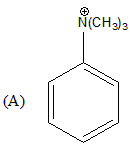
(A) C6H5N+(CH3)3 (structure A, trimethylanilinium ion) — This matches (II) Quaternary. The nitrogen carries four carbon groups (one phenyl, three methyl) and a positive charge, so it is a quaternary ammonium ion.
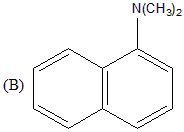
(B) N,N-Dimethylnaphthalen-1-amine (structure B) — This matches (I) Tertiary. The nitrogen carries the naphthyl group and two CH3 groups, so all three H atoms of NH3 are replaced.
(C) \((C_2H_5)_2CHNH_2\) (pentan-3-amine) — This matches (IV) Primary. Only one H of NH3 is replaced; the –NH2 group is on a secondary carbon, but the class of an amine depends on the nitrogen, not on that carbon.
(D) \((C_2H_5)_2NH\) (N-ethylethanamine) — This matches (III) Secondary. Two H atoms of NH3 are replaced by ethyl groups and one N–H is left.
NCERT (2026-27 edition):
Classification

Ammonolysis of Alkyl Halides – “… an alkyl or benzyl halide on reaction with an ethanolic solution of ammonia undergoes nucleophilic substitution reaction in which the halogen atom is replaced by an amino (–NH2) group. This process of cleavage of the C–X bond by ammonia molecule is known as ammonolysis. The reaction is carried out in a sealed tube at 373 K. The primary amine thus obtained behaves as a nucleophile and can further react with alkyl halide to form secondary and tertiary amines, and finally quaternary ammonium salt.”