A firm’s production function is Q = 5L1/2K1/2. It now uses 16 units of labour and 16 units of capital. Which of the following is correct?
Answer & explanation
Correct answer: option 3
The correct answer is Option (3) → Raising both L and K to 64 units gives 320 units of output (constant returns to scale); raising only L to 64 units gives 160 units.
Given:
Q = 5L1/2K1/2
L = 16, K = 16 at present
Put the values of L and K into the function each time.
\( \text{Now: } Q = 5 \times \sqrt{16} \times \sqrt{16} = 5 \times 4 \times 4 = 80 \)
\( \text{Both to 64: } Q = 5 \times \sqrt{64} \times \sqrt{64} = 5 \times 8 \times 8 = 320 \)
\( \text{Only L to 64: } Q = 5 \times \sqrt{64} \times \sqrt{16} = 5 \times 8 \times 4 = 160 \)
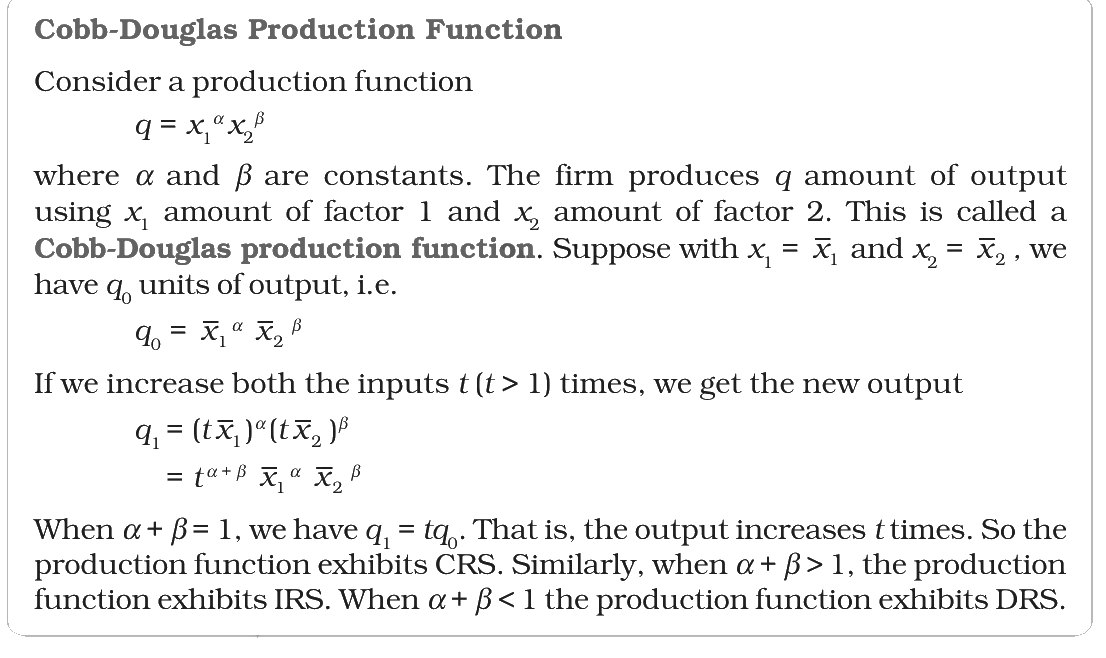
Both inputs rise 4 times and output also rises 4 times (80 to 320), so this is constant returns to scale; the powers add up to 1/2 + 1/2 = 1. With only labour raised, output is 160.
NCERT (2026-27): “Cobb-Douglas Production Function … When α + β = 1, we have q1 = tq0. That is, the output increases t times. So the production function exhibits CRS. Similarly, when α + β > 1, the production function exhibits IRS. When α + β < 1 the production function exhibits DRS.”
|