Arrange the following Peasant movements in chronological order from pre to post independent era.
A. The Naxalite Movement
B. Bhoodan Movement
C. Telangana Movement
D. Champaran Satyagrah
Choose the correct answer from the options given below:
Answer & explanation
Correct answer: option 3
The correct answer is Option (3) → D, C, B, A
D. Champaran Satyagrah — 1917–18, directed against the indigo plantations, under the leadership of Mahatma Gandhi.
C. Telangana Movement — 1946–51, at the time of Independence, against the feudal conditions in the princely state of Hyderabad; it was led by the Communist Party of India.
B. Bhoodan Movement — began in 1951, when Vinoba Bhave started asking landowners to gift a part of their land to the landless.
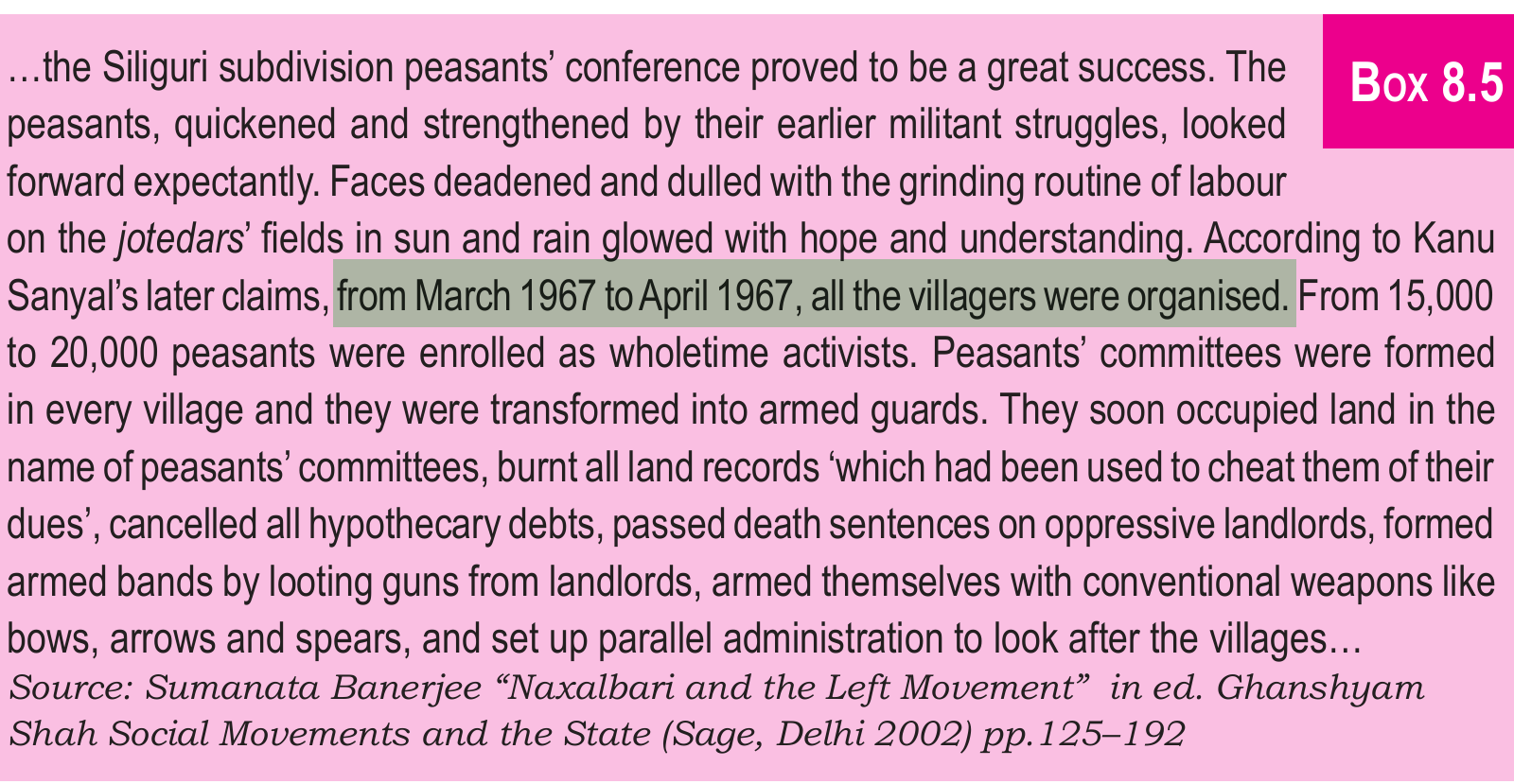
A. The Naxalite Movement — began in 1967 at Naxalbari in Bengal, when peasants rose against landlords.
Note: The sentence that dates the start of the Naxalite movement at Naxalbari (1967), in the section on peasant movements of the chapter ‘Social Movements’, was there in the pre-rationalised NCERT, which NTA followed in 2023. It has been deleted from the main text of the NCERT book (2025-26), though the chapter is still there and its box on the Naxalbari uprising still speaks of the events of 1967.
NCERT (2025-26): “Peasant Movements … Some of these issues continued into the following period, and under the leadership of Mahatma Gandhi became partially linked to the Independence movement. For instance, the Bardoli Satyagraha (1928, Surat District) a ‘non-tax’ campaign as part of the nationwide non-cooperation movement, a campaign of refusal to pay land revenue and the Champaran Satyagraha (1917–18) directed against indigo plantations.…” “…At the time of Independence, we had the two most classical cases of peasant movements, namely the Tebhaga movement (1946–47) and the Telangana movement (1946–51). The first was a struggle of sharecroppers in Bengal in North Bihar for two thirds share of their produce instead of the customary half. It had the support of the Kisan Sabha and the Communist Party of India (CPI). The second was directed against the feudal conditions in the princely state of Hyderabad and was led by the CPI.” NCERT (Pre-rationalised): “8.5 Class Based Movements … Certain issues which had dominated colonial times changed after independence. For land reforms, zamindari abolition, declining importance of land revenue and public credit system began to alter rural areas. The period after 1947 was characterised by two major social movements. The Naxalite struggle and the ‘new farmer’s movements.’ The Naxalite movement started from the region of Naxalbari (1967) in Bengal.”
Box 8.5 (Naxalbari, 1967) (NCERT 2025-26) |