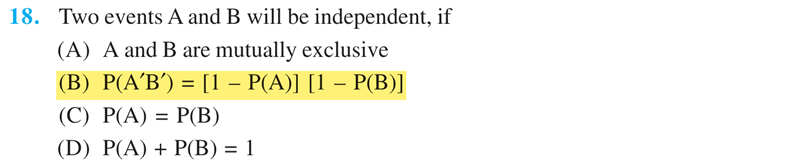
Two events A and B will be independent if
Answer & explanation
Correct answer: option 4
The correct answer is Option (4) → \(P(A'B') = [1 - P(A)][1 - P(B)]\)
A and B are independent when \(P(A \cap B) = P(A)\,P(B)\). Here A′B′ means \(A' \cap B'\), the event that neither happens. By De Morgan’s law:
\(P(A' \cap B') = 1 - P(A \cup B)\)
\(= 1 - P(A) - P(B) + P(A \cap B)\)
The right side of Option (4) expands to
\([1 - P(A)][1 - P(B)] = 1 - P(A) - P(B) + P(A)P(B)\)
The two are equal exactly when \(P(A \cap B) = P(A)P(B)\). So the condition in Option (4) is the same as independence (it says A′ and B′ are independent, which happens exactly when A and B are).
Why the other options are incorrect
Option (1) P(A) = P(B) — Incorrect. Equal probabilities say nothing about \(P(A \cap B)\). For example, A = B with \(P(A) = \frac{1}{2}\) gives \(P(A \cap B) = \frac{1}{2} \ne \frac{1}{4}\).
Option (2) P(A) + P(B) = 1 — Incorrect. For B = A′ this holds, but \(P(A \cap A') = 0\), not \(P(A)P(A')\) (unless one of them is 0).
Option (3) A and B are mutually exclusive events — Incorrect. Mutually exclusive is not independent: then \(P(A \cap B) = 0\), while \(P(A)P(B) \gt 0\) whenever both events are possible.
NCERT (2026-27 edition):
Independent Events