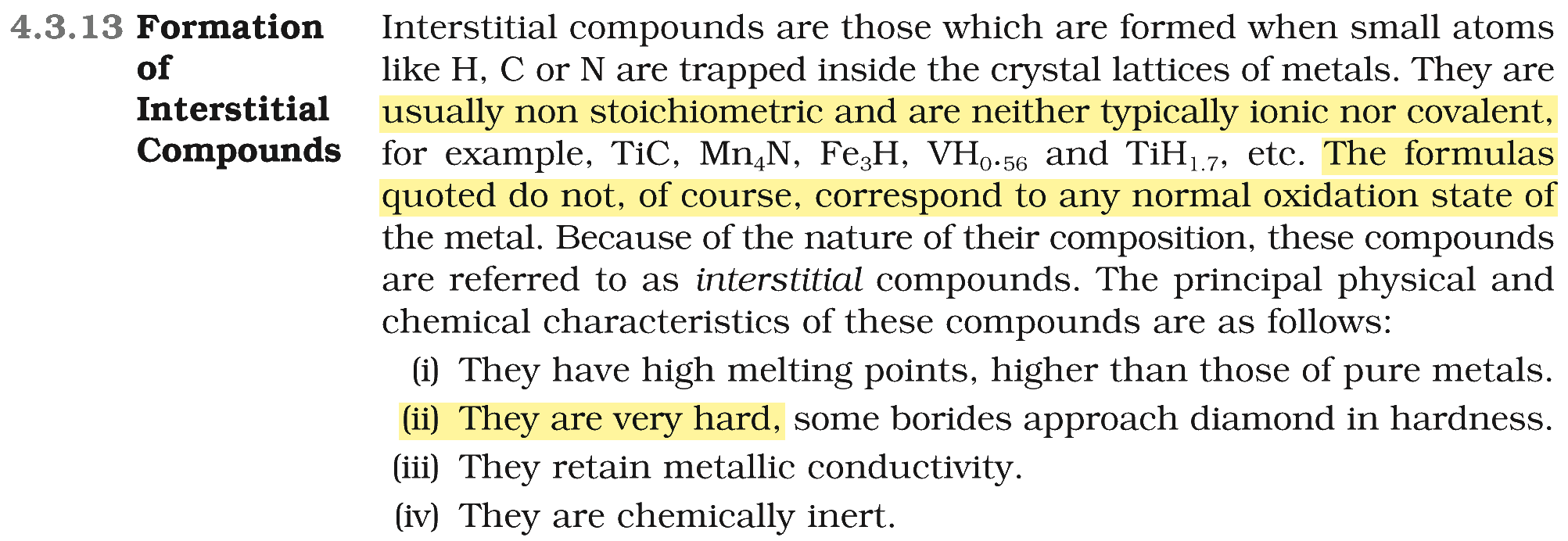
Choose the Incorrect statement about interstitial compounds:
Answer & explanation
Correct answer: option 3
The correct answer is Option (3) → Interstitial compounds are typically covalent in nature
Interstitial compounds are formed when small atoms such as H, C or N are trapped in the holes of the crystal lattice of a transition metal.
Option (1) They are usually non-stoichiometric compounds — True of interstitial compounds. The number of trapped atoms depends on how many holes are filled, so the formulas are not simple whole-number ratios.
Option (2) Metal atom does not bear normal oxidation state in interstitial compounds — True of interstitial compounds. The small atoms only occupy holes, so the formula does not correspond to any normal oxidation state of the metal.
Option (3) Interstitial compounds are typically covalent in nature — Not true of interstitial compounds. They are neither typically ionic nor covalent; the metal lattice is kept, so they still show metallic properties such as conductivity.
Option (4) Interstitial compounds are very hard — True of interstitial compounds. The trapped atoms lock the metal layers in place, so these compounds are very hard and melt higher than the pure metals.
NCERT (2026-27 edition):
Formation of Interstitial Compounds