
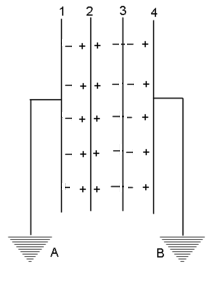
Four large metal plates are located a small distance apart from one another as shown in the Figure. The extreme plates are connected by means of a conductor, while a potential difference V is applied to the internal plates. Find the electric fields between the neighbouring plates.
Answer & explanation
Correct answer: option 1
We may take the plates to be connected as shown in the Figure.
Let E23 be the electric field between plates 2 and 3. Then from the fact that electric field = rate of change of potential, $E_{22}=\frac{V}{d}$.
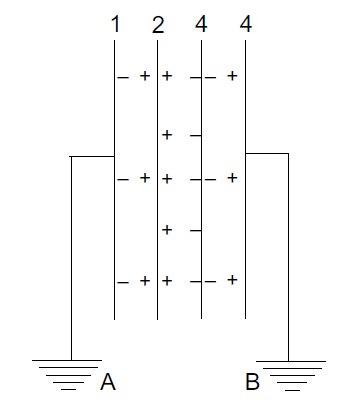
Applying `loop rule' to the loop
`A – 1 – 2 – 3 – 4 – B – A'
V' – V – + V' ⇒ V' = $\frac{V}{2}$
where V' is the numerical value of the potential difference between plates 1 and 2 or 3 and 4
∴ $E_{12}$ or $E_{34} = \frac{V}{2 d}$
$E = \frac{\sigma}{\varepsilon_0}$
∴ $\sigma_1$ (density of charge on the plate 1)
$=\varepsilon_0 E_{12}=\varepsilon_0 \frac{V}{2 d}=\sigma_4$ (numerically)
The surface density of charge of the right surface of plate 2 is $\sigma'=\varepsilon_0, E_{23}=\varepsilon_0 V d$
∴ $\sigma_2$ (surface density of charge on plate 2)
$=\frac{\varepsilon_0 V}{2 d}+\frac{\varepsilon_0 V}{d}=\frac{3}{2} \frac{\varepsilon_0 V}{d}$
Thus
(i) $E_{23}=\frac{V}{d} E_{12}$ or $E_{34}=\frac{V}{2 d}$
(ii) $\sigma_1=\sigma_4=\varepsilon_0 \frac{V}{2 d} \sigma_2=\varepsilon_0=\frac{3}{2} \varepsilon_0 \frac{V}{d}$.