
Consider the following LPP:
Maximise \(Z=9x+3y\)
Subject to the constraints: \(x+3y \le 60,\ x-y \le 0,\ x \ge 0,\ y \ge 0\)
If \(x=A,\ y=B\) is the optimum solution of the given LPP, then the value of \(A+B\) is:
Answer & explanation
Correct answer: option 2
The correct answer is Option (2) → 30
The constraint \(x - y \le 0\) means \(x \le y\): the region lies on or above the line y = x. With \(x + 3y \le 60\) and \(x \ge 0\), the feasible region is the triangle with corners (0, 0), (0, 20) and (15, 15).
The line x + 3y = 60 meets the y-axis where x = 0:
\(3y = 60,\quad y = 20\)
It meets the line y = x where
\(x + 3x = 60,\quad x = 15,\quad y = 15\)
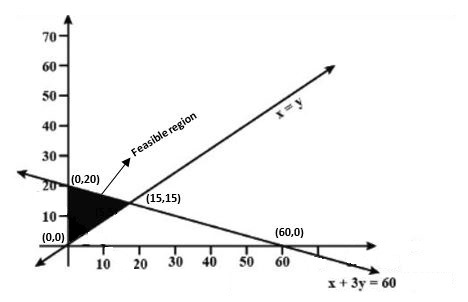
Values of Z = 9x + 3y at the corner points:
\(Z(0, 0) = 0\)
\(Z(0, 20) = 60\)
\(Z(15, 15) = 135 + 45 = 180\)
The maximum, 180, is at (15, 15), so A = 15 and B = 15:
\(A + B = 15 + 15 = 30\)