CUETMOCK
  • Pricing
  • Mentors
Log inStart freeStart free mocks→

First test, then trust

Try a free CUET mock test.

Join 5,00,000+ students who rehearsed exam day on the exact NTA screen before sitting CUET. On the web and on Android.

Start free mocks →Get the Android app
CUETMOCK

India's #1 CUET Mock Test Platform. Original NCERT-based questions on the exact NTA exam screen — trusted by 5,00,000+ students since CUET 2022.

Get it onGoogle PlayScan to download the CUETMOCK app

Mock tests

  • CUET mock test series
  • Browse all papers
  • Commerce mocks
  • Humanities (Arts) mocks
  • Science mocks
  • Languages & GAT mocks
  • Free practice questions
  • Pricing

Resources

  • CUET exam guide
  • CUET syllabus
  • Universities accepting CUET
  • Expert blogs
  • News & notifications
  • Webinars & counselling
  • CUET score calculator
  • How we estimate your rank
  • FAQs

Company

  • About us
  • Our leadership & team
  • Our toppers
  • Mentors
  • For schools
  • Contact us
  • Terms
  • Privacy
  • Refund policy

Talk to us

+91 7696 6630 56info@cuetmock.comWhatsApp us

Our other platforms

  • JEE Mock — For IIT-JEE aspirants
  • NEET Mock — For NEET aspirants

Newsletter

Exam updates, study material and offers — no spam.

© 2026 NYC Ventures Pvt. Ltd.

701-702, Royal Business Park, Zirakpur, Punjab - 140603

  • Terms of use
  • Privacy policy
  • Refund policy
  • Contact us

iCUETMOCK is an independent preparation platform, not affiliated with the National Testing Agency (NTA). Always check exam details on the official NTA website.

  • Home
  • Mock tests
  • CUET guide
  • Pricing
  • Log in
Home/Practice questions/Economics
EconomicsIndian Economic Development: Poverty

Categorize poverty in ascending orderA. Chronic PoorB. Non-poorC. Chu…

Categorize poverty in ascending order

A. Chronic Poor

B. Non-poor

C. Churning Poor

D. Occasionally Poor

E. Antyodaya

Choose the correct answer from the options given below:

Answer & explanation+

Correct answer: option 4

The correct answer is Option (4) → E, A, C, D, B

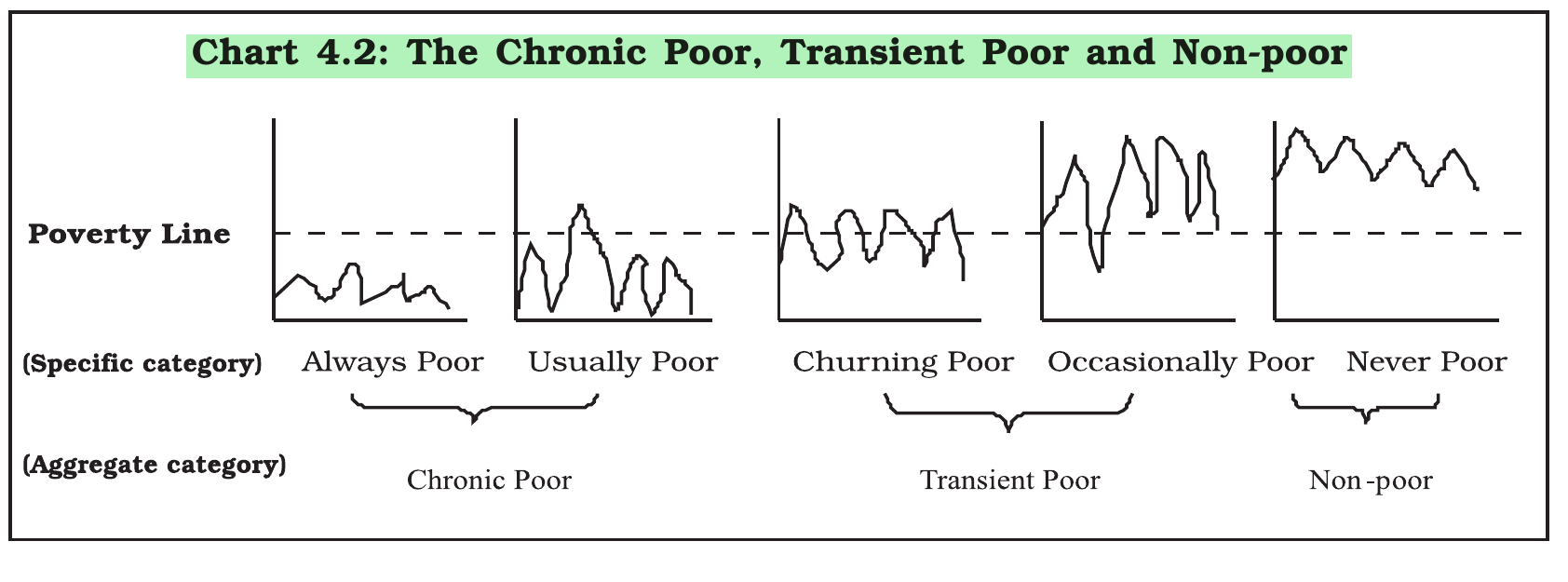
Poor people are grouped by how long they stay poor. Going up from the poorest to the least poor, the groups follow one another as below.

(E) Antyodaya — it means the poorest of the poor. The five year plans laid emphasis on their upliftment.

(A) Chronic Poor — people who are always poor, or usually poor with a little more money now and then, such as casual workers.

(C) Churning Poor — people who regularly move in and out of poverty, such as small farmers and seasonal workers.

(D) Occasionally Poor — people who are rich most of the time but sometimes have a patch of bad luck. The churning poor and the occasionally poor together are called the transient poor.

(B) Non-poor — people who are never poor.

Note: This question is taken from the chapter ‘Poverty’ which was there in the pre-rationalised NCERT and has been deleted from subsequent editions of NCERT, including the NCERT book (2026-27). The chapter was also not in the CUET (UG) 2026 syllabus.

NCERT (Pre-rationalised): “4.1 Introduction …Providing minimum basic needs to the people and reduction of poverty have been the major aims of independent India. The pattern of development that the successive five year plans envisaged laid emphasis on the upliftment of the poorest of the poor (Antyodaya), integrating the poor into the mainstream and achieving a minimum standard of living for all.…

4.3 How are Poor People Identified? … Categorising Poverty: There are many ways to categorise poverty. In one such way people who are always poor and those who are usually poor but who may sometimes have a little more money (example: casual workers) are grouped together as the chronic poor. Another group are the churning poor who regularly move in and out of poverty (example: small farmers and seasonal workers) and the occasionally poor who are rich most of the time but may sometimes have a patch of bad luck. They are called the transient poor. And then, there are those who are never poor and they are the non-poor (Chart 4.2).…”

NCERT extract

Advertisement

Practise more on Indian Economic Development: Poverty

Chapter-wise mocks on the real NTA exam screen, with solutions and your rank. Your first mocks are free.

Start free mocks →

Advertisement

Next questions

  1. If ₹64 amounts to ₹83.20 in 2 years on simple interest, then how much will ₹86 amount to in 4 years at the same rate percent per annum?General Aptitude Test · Numerical Ability
  2. _____ refers to the number of females per 1000 males in a given area at a specified time period.Sociology · Indian Society: Demographic Structure of Indian Society
  3. Arrange the following words as per the order in the dictionary: 1. determine, 2. detective, 3. determined, 4. developGeneral Aptitude Test · Verbal Reasoning
  4. Fill in the blank with the suitable determiner:It is ______ unanimous decision taken by the team :English · Grammar: Articles
  5. In presence of high concentration of oxygen, RuBP carboxylase converts RuBP to :Biology · Photosynthesis in Higher Plants
  6. Let a and b be two unit vectors such that a + b is also a unit vector. Then what is the angle a and b ?Maths. Section B1 · Vectors
  7. Which of the following pairs is correctly matched?Economics · Micro Economics: Theory of Consumer behaviour
  8. An ordinary analog Clock seen through a mirror shows the time as Quarter past Nine. What will be the correct time at that instant?General Aptitude Test · Verbal Reasoning
  9. What is rayon commonly known as?Chemistry · Organic: Polymers
  10. Select the most appropriate SYNONYM of the given word. INSATIABLEEnglish · Synonyms