Read the passage and answer the questions:
“I think it would be extremely dangerous for them if they were segregated from the rest of the community and kept aloof in an air-tight compartment where they would have to rely on others even for the air they breathe... The minorities if they are returned by separate electorates can never have any effective voice”.
Speaker fears that a separate electorate would result in:
Answer & explanation
Correct answer: option 4
The correct answer is Option (4) → Divided loyalties
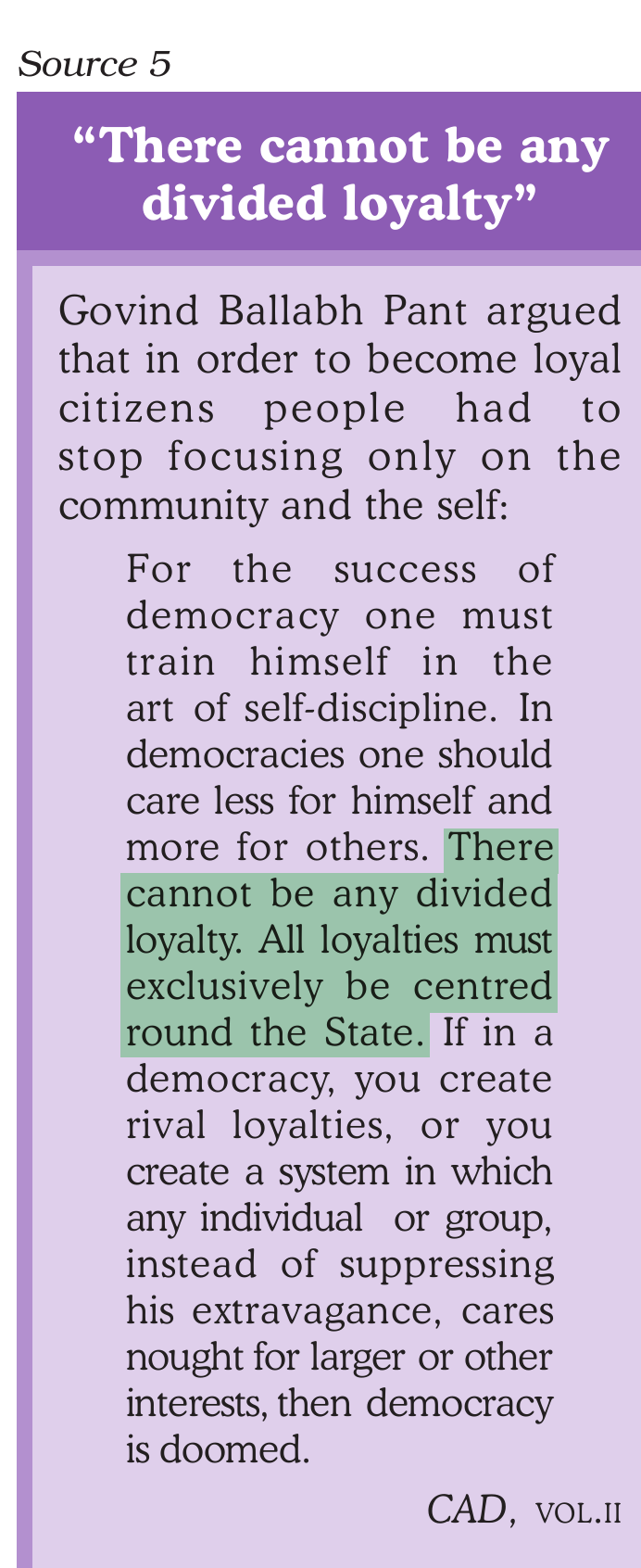
Govind Ballabh Pant opposed separate electorates as a suicidal demand that would permanently isolate the minorities. In his view, communities could be recognised as cultural entities and given cultural rights, but politically all of them had to act as equal members of one State, or else there would be divided loyalties. Separate electorates would make each community look to itself and not to the State.
Option (1) Assimilation of minorities — Incorrect. Assimilation is what Pant wanted: every group had to be assimilated within the nation. Separate electorates would do the opposite and keep the minorities apart in an “air-tight compartment”.
Option (2) Assured cultural rights to minorities — Incorrect. Pant himself accepted that communities could be assured cultural rights. This was something he offered, not a danger he feared from separate electorates.
Option (3) Equal Citizenship Rights — Incorrect. Equal citizenship was Pant’s own remedy: it is the citizen that must count, and members of every community were to act as equal members of one State. Separate electorates would work against it, not result in it.
NCERT (2026-27): “3.1 The problem with separate electorates … Countering the demand for separate electorates, Govind Ballabh Pant declared that it was not only harmful for the nation but also for the minorities. He agreed with Bahadur that the success of a democracy was to be judged by the confidence it generated amongst different sections of people. He agreed too that every citizen in a free state should be treated in a manner that satisfied ‘not only his material wants but also his spiritual sense of self-respect’, and that the majority community had an obligation to try and understand the problems of minorities, and empathise with their aspirations. Yet Pant opposed the idea of separate electorates. It was a suicidal demand, he argued, that would permanently isolate the minorities, make them vulnerable, and deprive them of any effective say within the government.… 3.1 The problem with separate electorates … The Constitution would grant to citizens rights, but citizens had to offer their loyalty to the State. Communities could be recognised as cultural entities and assured cultural rights. Politically, however, members of all communities had to act as equal members of one State, or else there would be divided loyalties. ‘There is the unwholesome and to some extent degrading habit of thinking always in terms of communities and never in terms of citizens,’ said Pant. And he added: ‘Let us remember that it is the citizen that must count. It is the citizen that forms the base as well as the summit of the social pyramid.’ Even as the importance of community rights was being recognised, there was a lurking fear among many nationalists that this may lead to divided loyalties, and make it difficult to forge a strong nation and a strong State.…”
|