
The area of a rhombus is 256 sq cm and one of its diagonals is twice the other in length. What is the length of the smaller diagonal?
Answer & explanation
Correct answer: option 1
The correct answer is Option (1) → 16 cm
The area of a rhombus is half the product of its diagonals, \(\frac{1}{2}d_1d_2\).
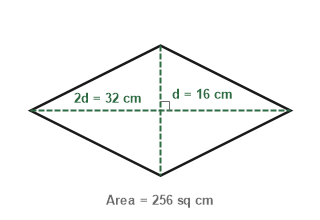
Let the smaller diagonal be \(d\); the larger is \(2d\)
\(\displaystyle \frac{1}{2}\times d\times2d=256\), so \(d^2=256\)
\(d=16\) cm (the larger diagonal is 32 cm)
Why the other options are incorrect
Option (2) 18 cm — Incorrect. With diagonals 18 cm and 36 cm the area would be 324 sq cm.
Option (3) 32 cm — Incorrect. This is the larger diagonal, not the smaller one.
Option (4) 36 cm — Incorrect. With diagonals 36 cm and 72 cm the area would be 1296 sq cm.