Assertion (A): Carboxylic acids have higher boiling points than alkanes.
Reason (R): Carboxylic acids are resonance hybrids.
Answer & explanation
Correct answer: option 2
The correct answer is Option (2) → Both Assertion and Reason are correct and the Reason is not the correct explanation for the Assertion.
Assertion (A): Carboxylic acids have higher boiling points than alkanes. — True. Carboxylic acid molecules are held together by intermolecular hydrogen bonds between the O–H of one molecule and the oxygen of another. Alkane molecules cannot form hydrogen bonds and attract each other only weakly. More energy is needed to separate the acid molecules, so they boil higher.
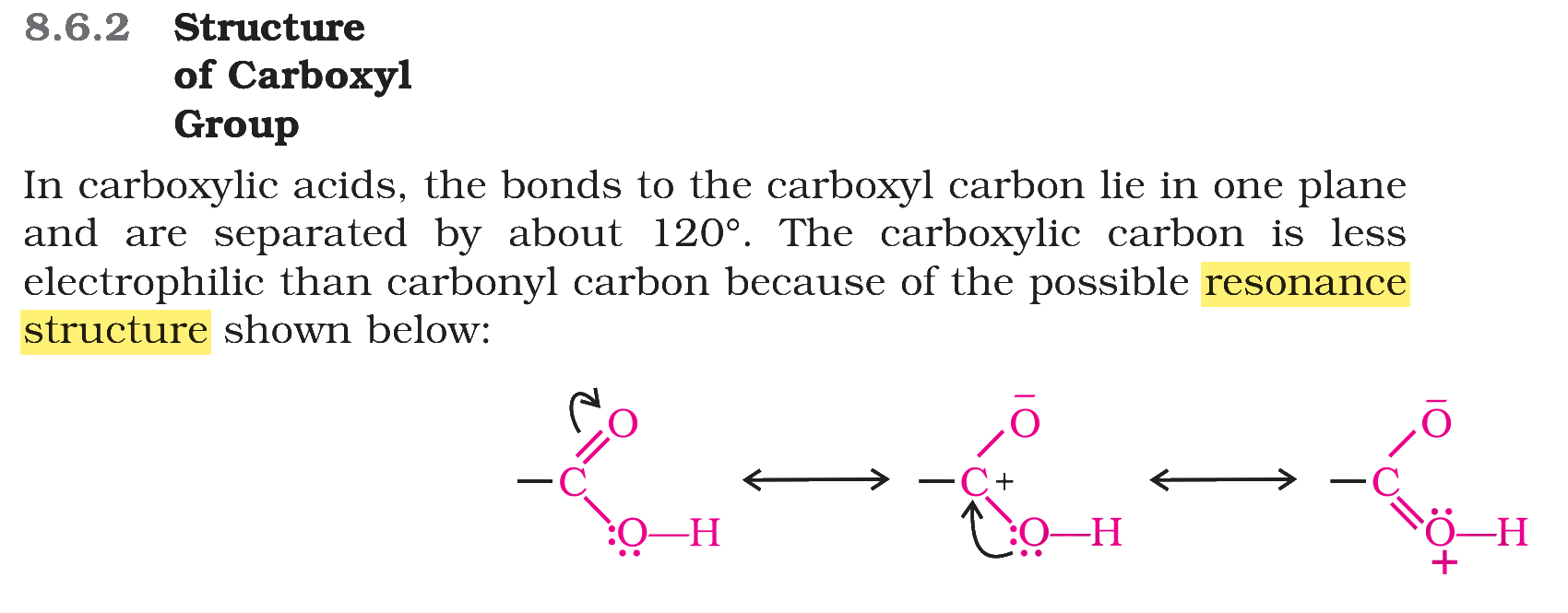
Reason (R): Carboxylic acids are resonance hybrids. — True. In the –COOH group a lone pair on the oxygen of O–H is delocalised towards the \( \ce{C=O} \) group, so the carboxyl group is a resonance hybrid. This is why the carboxyl carbon is less electrophilic than a carbonyl carbon.
Why Reason (R) does not explain Assertion (A)?
The Assertion is about the forces between molecules: a boiling point depends on how strongly one molecule holds the next. The Reason is about how electrons are spread within one carboxyl group.
Resonance inside a molecule is not an attraction between molecules; the high boiling point comes from hydrogen bonding. So both are true, but R is not the reason for A.
NCERT (2026-27 edition):
8.8 Physical Properties – “… Carboxylic acids are higher boiling liquids than aldehydes, ketones and even alcohols of comparable molecular masses. This is due to more extensive association of carboxylic acid molecules through intermolecular hydrogen bonding.”
8.3 Physical Properties – “… The boiling points of aldehydes and ketones are higher than hydrocarbons and ethers of comparable molecular masses.”
8.6.2 Structure of Carboxyl Group