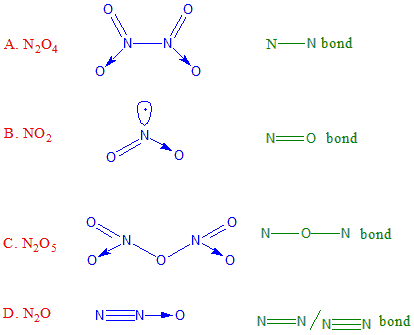
Match List I with List II:
|
List I Oxide |
List II Type of Bond |
| A. \(N_2O_4\) | I. \(N=O\) bond |
| B. \(NO_2\) | II. \(N-O-N\) bond |
| C. \(N_2O_5\) | III. \(N-N\) bond |
| D. \(N_2O\) | IV. \(N=N / N≡N\) bond |
Choose the correct answer from the options given below:
Answer & explanation
Correct answer: option 2
The correct answer is option 2. A-III, B-I, C-II, D-IV.
|
List I Oxide |
List II Type of Bond |
| A. \(N_2O_4\) | III. \(N-N\) bond |
| B. \(NO_2\) | I. \(N=O\) bond |
| C. \(N_2O_5\) | II. \(N-O-N\) bond |
| D. \(N_2O\) | IV. \(N=N / N≡N\) bond |
Here is the breakdown of the correct matching:
A-III: Dinitrogen tetroxide (N₂O₄) has two N-O-N bonds (single bonds between two nitrogen atoms and a single bond to oxygen).
B-I: Nitrogen dioxide (NO₂) has a single N=O bond (double bond between nitrogen and oxygen).
C-II: Dinitrogen pentoxide (N₂O₅) has both N-O-N bonds and a single N-O-N bond connected to an N=O bond in a specific configuration.
D-IV: Nitrous oxide (N₂O) has a single N-N bond and a single N=O bond.