Read the passage and answer the following questions.
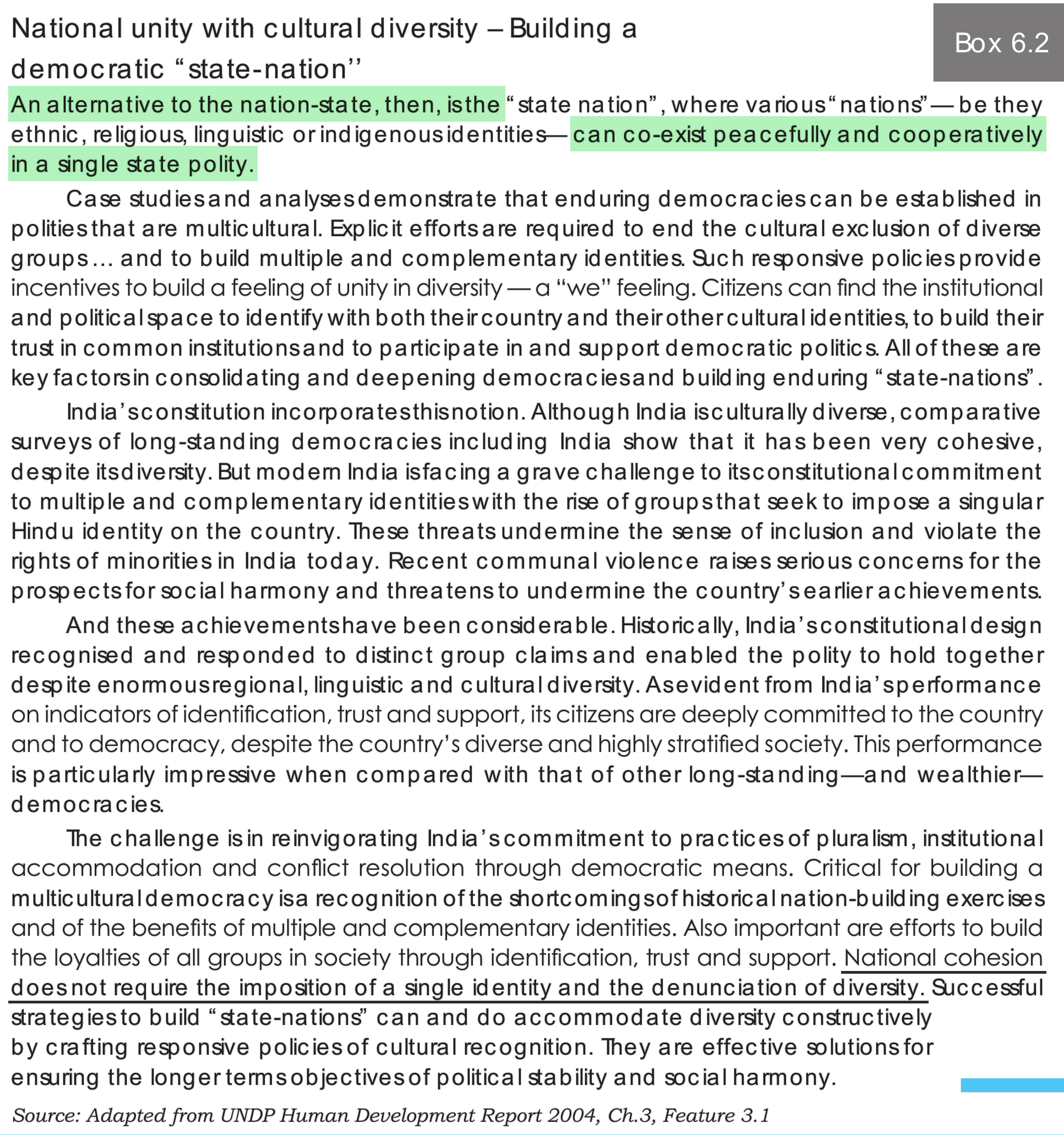
An alternative to the nation-state, then, is the "state nation", where various "nations" - be they ethnic, religious, linguistic or indigenous identities - can co-exist peacefully and cooperatively in a single state polity.
Case studies and analyses demonstrate that enduring democracies can be established in polities that are multicultural. Explicit efforts are required to end the cultural exclusion of diverse groups... and to build multiple and complementary identities. Such responsive policies provide incentives to build a feeling of unity in diversity- a "we" feeling. Citizens can find the institutional and political space to identify with both their country and their other cultural identities, to build their trust in common institutions and to participate in and support democratic politics. All of these are key factors in consolidating and deepening democracies and building enduring "state nations".
India's constitution incorporates this notion. Although India is culturally diverse, comparative surveys of long-standing democracies including India show that it has been very cohesive, despite its diversity.
And these achievements have been considerable. Historically, India's constitutional design recognised and responded to distinct group claims and enabled the polity to hold together despite enormous regional, linguistic and cultural diversity. As evident from India's performance on indicators of identification, trust and support its citizens are deeply committed to the country and to democracy, despite the country's diverse and highly stratified society. This performance is particularly impressive when compared with that of other long-standing and wealthier - democracies.
The challenge is in reinvigorating India's commitment to practices of pluralism, institutional accommodation and conflict resolution through democratic means. Critical for building a multicultural democracy is a recognition of the shortcomings of historical nation-building exercises and of the benefits of multiple and complementary identities. Also important are efforts to build the loyalties of all groups in society through identification, trust and support. National cohesion does not require the imposition of a single identity and the denunciation of diversity. Successful strategies to build "state-nations" can and do accommodate diversity constructively by crafting responsive policies of cultural recognition. They are effective solutions for ensuring the longer term objectives of political stability and social harmony.
A state-nation consists of:
Answer & explanation
Correct answer: option 1
The correct answer is Option (1) → co-existence of plural identities within one state.
Option (1) co-existence of plural identities within one state. — Correct. A ‘state nation’ is the alternative to the nation-state. In it various ‘nations’, be they ethnic, religious, linguistic or indigenous identities, co-exist peacefully and cooperatively in a single state polity.
Option (2) one nation, one state, one religion — Incorrect. This is the idea of a nation-state, here built on a single religion. In recent times nation-states have rested on a one-to-one bond, one nation, one state. A state-nation is the alternative to it: many religious identities live together in one state, and no single religion is made the basis of the nation.
Option (3) one nation, one state, one language — Incorrect. This too is the nation-state model, built on a single language. A state-nation lets linguistic identities co-exist as well. When Sri Lanka made Sinhala its sole official language despite the protests of the Tamils, a member of its Parliament warned: ‘One language, two nations’.
Option (4) assimilation of plural identities within one state — Incorrect. Assimilation means making all citizens give up their own cultural values and adopt those of the dominant group. It erodes the differences that a state-nation lets co-exist.
NCERT: Indian Society — Chapter 6: The Challenges of Cultural Diversity, Box 6.2 (2025-26)
|