When benzene diazonium chloride is treated with halogen acid in the presence of copper powder, the reaction is referred to as
Answer & explanation
Correct answer: option 2
The correct answer is Option (2) → Gatterman reaction
In a benzene diazonium salt the group \( \ce{-N2+} \) is an excellent leaving group, because it leaves as nitrogen gas. It can be replaced by halogens or the cyano group in two related ways:
Sandmeyer reaction: the diazonium salt is treated with a copper(I) salt, CuCl/HCl, CuBr/HBr or CuCN/KCN.
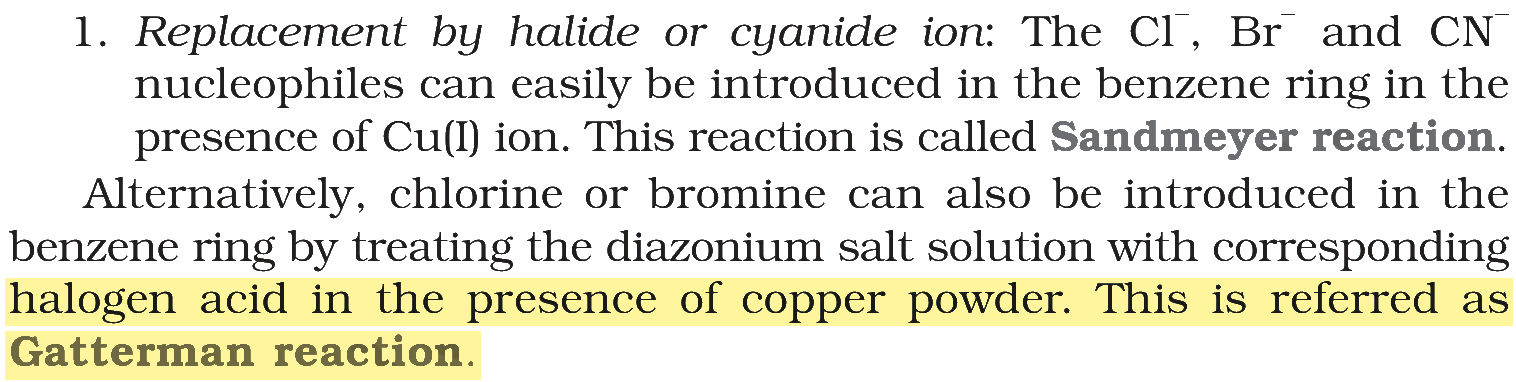
Gattermann reaction: the diazonium salt is treated with the halogen acid in the presence of copper powder.
The reaction in the question uses a halogen acid with copper powder, so it is the Gattermann reaction:
\( \displaystyle \ce{C6H5N2+Cl^-} \xrightarrow{\text{Cu/HCl}} \ce{C6H5Cl + N2} \)
\( \displaystyle \ce{C6H5N2+Cl^-} \xrightarrow{\text{Cu/HBr}} \ce{C6H5Br + N2} \)
Why the other options are incorrect
Option (1) Finkelstein reaction — Incorrect. This is halogen exchange in alkyl halides: an alkyl chloride or bromide is heated with NaI in dry acetone, and the NaCl or NaBr formed precipitates, driving the reaction forward.
\( \displaystyle \ce{R-X + NaI} \xrightarrow{\text{dry acetone}} \ce{R-I + NaX} \)
Option (3) Sandmeyer's reaction — Incorrect. It also starts from the diazonium salt, but the reagent is a copper(I) salt (CuCl, CuBr or CuCN), not copper powder with the acid.
\( \displaystyle \ce{C6H5N2+Cl^-} \xrightarrow{\ce{CuCl}/\ce{HCl}} \ce{C6H5Cl + N2} \)
Option (4) Hell-Volhard-Zelinsky reaction — Incorrect. This is the α-halogenation of a carboxylic acid with chlorine or bromine and red phosphorus; no diazonium salt is involved.
\( \displaystyle \ce{R-CH2-COOH} \xrightarrow[\text{(ii) }\ce{H2O}]{\text{(i) }\ce{X2}/\text{red P}} \ce{R-CH(X)-COOH} \)
NCERT (2026-27 edition):
Replacement by Halide or Cyanide Ion