Fehling solution gives red precipitate with.....
Answer & explanation
Correct answer: option 3
The correct answer is Option (3) → Aliphatic Aldehyde
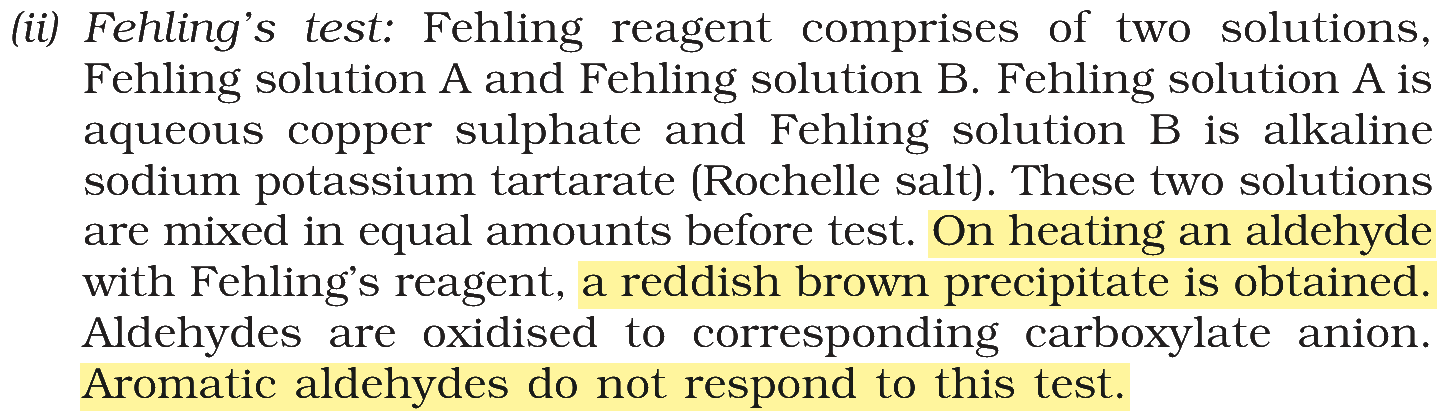
Aldehydes differ from ketones in having a hydrogen atom on the carbonyl carbon, so they are easily oxidised to carboxylic acids, even by mild oxidising agents. Fehling’s reagent is made by mixing equal volumes of Fehling solution A (aqueous copper sulphate) and Fehling solution B (alkaline sodium potassium tartrate). On heating an aldehyde with it, \( \ce{Cu^2+} \) is reduced to copper(I) oxide, which appears as a reddish brown precipitate, and the aldehyde is oxidised to the carboxylate ion:
\( \displaystyle \ce{R-CHO + 2Cu^2+ + 5OH^- -> R-COO^- + Cu2O v + 3H2O} \)
Aliphatic aldehydes such as ethanal give this test. So Fehling solution gives a red precipitate with an aliphatic aldehyde.
Why the other options are incorrect
Option (1) Aromatic aldehyde — Incorrect. Aromatic aldehydes such as benzaldehyde do not respond to Fehling’s test, though they give the silver mirror with Tollens’ reagent.
Option (2) Ketone — Incorrect. A simple ketone has no hydrogen on the carbonyl carbon and is not oxidised by a mild oxidising agent such as Fehling’s solution.
Option (4) Carboxylic acid — Incorrect. A carboxylic acid is already the oxidation product of an aldehyde, so it cannot reduce \( \ce{Cu^2+} \) any further.
Note: In the original NTA paper, Option (4) was printed as “α-Hydroxy aromatic ketone”. An α-hydroxy ketone such as benzoin, \( \ce{C6H5-CH(OH)-CO-C6H5} \), is also oxidised by Fehling’s solution and gives the red precipitate of \( \ce{Cu2O} \), so the question had two correct answers. So that students are not confused and the question has a single answer, Option (4) has been changed to “Carboxylic acid”.
NCERT (2026-27 edition):
Fehling’s Test