
Solve the following inequalities for x:
$\frac{x+3}{x-4}≥0$
Answer & explanation
Correct answer: option 1
The correct answer is Option (1) → $(−∞,−3]∪(4,∞)$
Given $\frac{x+3}{x-4}≥0$. First, we note that $x ≠ 4$.
Since $(x-4)^2 > 0$ for all $x ∈ R, x ≠4,$
$\frac{x+3}{x-4}≥0⇒(x+3)(x-4) ≥0$ (multiplying by $(x-4)^2$)
$⇒ (x-(-3)) (x −4) ≥ 0$ ...(1)
Mark the numbers -3 and 4 on the number line.
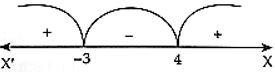
By the method of intervals, the inequality (1) is satisfied when $x ≥ 4$ or $x < -3$ but $x ≠ 4$.
∴ The solution set is $(−∞,−3]∪(4,∞)$.