Which set of reagents will be most suitable to bring about the following change?
2,4,6-Trinitrochlorobenzene to picric acid
Answer & explanation
Correct answer: option 3
The correct answer is Option (3) → Warm water
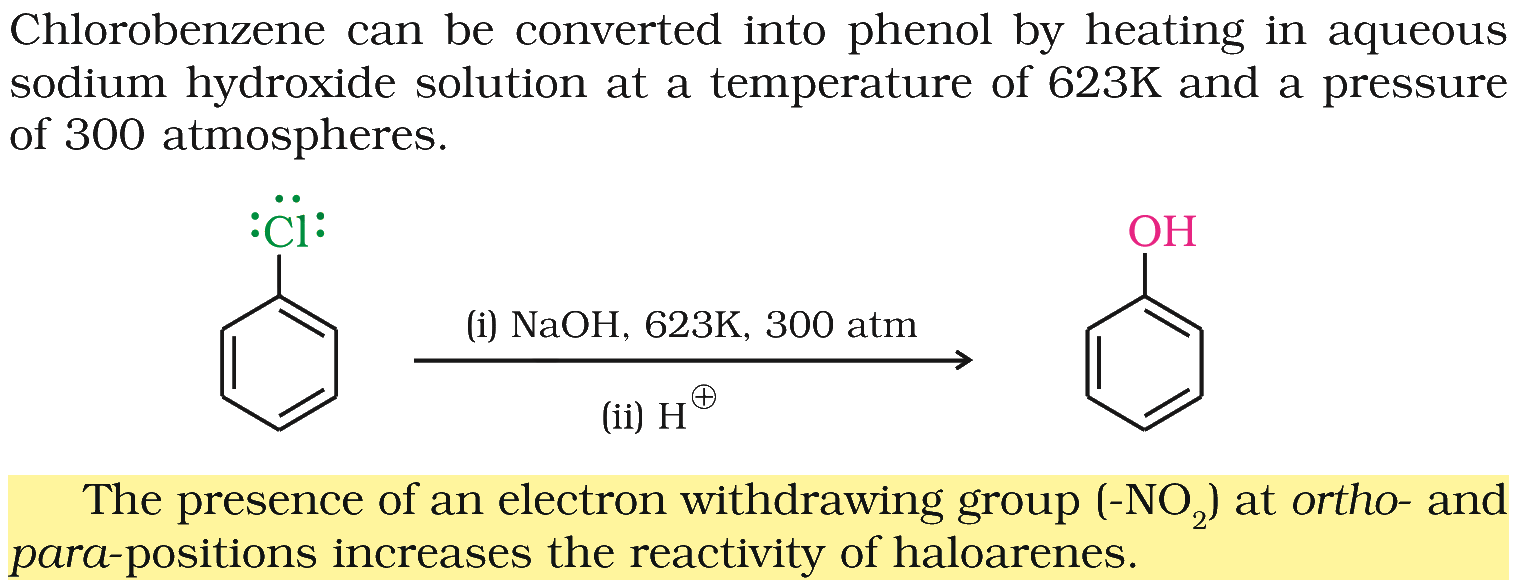
Chlorobenzene itself is converted to phenol only by aqueous NaOH at 623 K and 300 atm, because the C–Cl bond of a haloarene has partial double bond character. –NO2 groups at the ortho and para positions withdraw electron density from the ring, make the carbon bearing Cl strongly electron deficient and stabilise the intermediate carbanion. With three such groups the substitution is so easy that warm water is enough:
2,4,6-trinitrochlorobenzene \( \xrightarrow{\text{warm } \ce{H2O}} \) 2,4,6-trinitrophenol (picric acid)
Why the other options are incorrect
Option (1) NaOH, 623 K, 300 atm — Incorrect. The condition for unactivated chlorobenzene; it is not needed here, and hot strong alkali would turn the acidic picric acid into its sodium salt.
Option (2) Hot conc. sulphuric acid — Incorrect. An acid does not supply the nucleophile; it is water that replaces Cl.
Option (4) Acidified water — Incorrect. Added acid is not needed and does not help; warm water alone brings about the substitution.
NCERT (2026-27 edition):
Reactions of Haloarenes – …