In nucleophilic addition reaction of HCN to ethanal, the hybridisation of the carbonyl carbon in the final product is
Answer & explanation
Correct answer: option 1
The correct answer is Option (1) → sp3
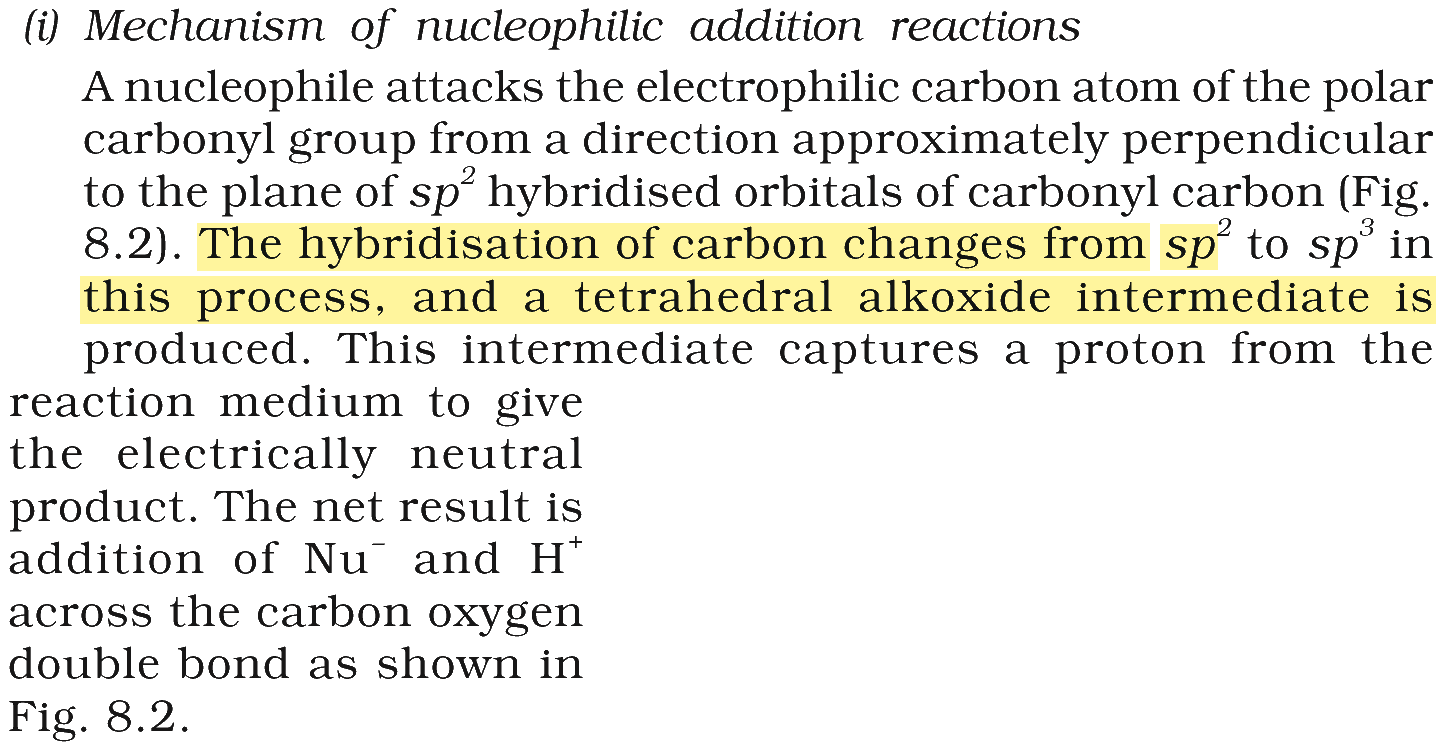
The carbonyl carbon of an aldehyde is sp2 hybridised and trigonal planar. It is electrophilic because oxygen pulls electron density away from it.
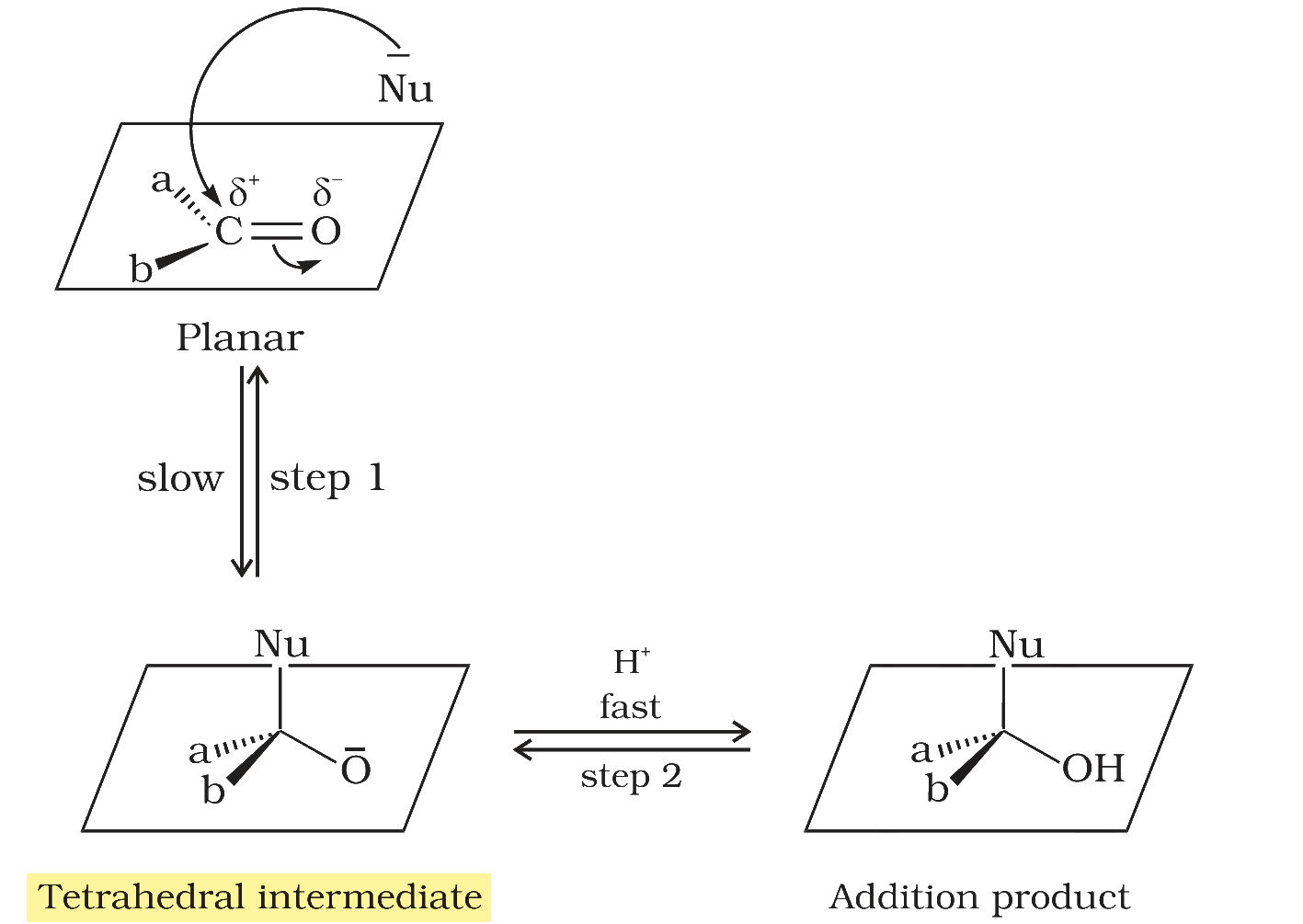
In nucleophilic addition, the nucleophile attacks this carbon from above or below the plane. The C=O π bond breaks, and the carbon becomes bonded to four groups in a tetrahedral intermediate, so its hybridisation changes from sp2 to sp3. Protonation of the oxygen then gives the product.
With HCN (catalysed by a base, which provides \( \ce{CN^{-}} \)), ethanal gives a cyanohydrin:
\( \displaystyle \ce{CH3CHO + HCN -> CH3CH(OH)CN} \)
In the product, 2-hydroxypropanenitrile, the former carbonyl carbon carries four single bonds (to \( \ce{CH3} \), H, OH and CN). So it is sp3 hybridised.
Why the other options are incorrect
Option (2) sp2 — Incorrect. This is the hybridisation of the carbonyl carbon before addition, while it still has the C=O double bond.
Option (3) sp2d — Incorrect. Carbon is a second period element with no d orbitals in its valence shell, so it cannot use d orbitals in hybridisation.
Option (4) spd2 — Incorrect. For the same reason, no hybridisation involving d orbitals is possible for carbon.
NCERT (2026-27 edition):
Mechanism of Nucleophilic Addition Reactions