
CUETMOCK
  • Pricing
  • Mentors
Log inStart freeStart free mocks→

First test, then trust

Try a free CUET mock test.

Join 5,00,000+ students who rehearsed exam day on the exact NTA screen before sitting CUET. On the web and on Android.

Start free mocks →Get the Android app
CUETMOCK

India's #1 CUET Mock Test Platform. Original NCERT-based questions on the exact NTA exam screen — trusted by 5,00,000+ students since CUET 2022.

Get it onGoogle PlayScan to download the CUETMOCK app

Mock tests

  • CUET mock test series
  • Commerce mocks
  • Humanities (Arts) mocks
  • Science mocks
  • Languages & GAT mocks
  • Free practice questions
  • Pricing

Resources

  • CUET exam guide
  • CUET syllabus
  • Universities accepting CUET
  • Expert blogs
  • News & notifications
  • Webinars & counselling
  • CUET score calculator
  • How we estimate your rank
  • FAQs

Company

  • About us
  • Our leadership & team
  • Our toppers
  • Mentors
  • For schools
  • Contact us
  • Terms
  • Privacy
  • Refund policy

Talk to us

+91 7696 6630 56info@cuetmock.comWhatsApp us

Our other platforms

  • JEE Mock — For IIT-JEE aspirants
  • NEET Mock — For NEET aspirants

Newsletter

Exam updates, study material and offers — no spam.

© 2026 NYC Ventures Pvt. Ltd.

701-702, Royal Business Park, Zirakpur, Punjab - 140603

  • Terms of use
  • Privacy policy
  • Refund policy
  • Contact us

iCUETMOCK is an independent preparation platform, not affiliated with the National Testing Agency (NTA). Always check exam details on the official NTA website.

  • Home
  • Mock tests
  • CUET guide
  • Pricing
  • Log in
Home/Practice questions/Chemistry
ChemistryPhysical: Solutions

The figure shows how the vapour pressure of a pure solvent and of a s…

The figure shows how the vapour pressure of a pure solvent and of a solution of a non-volatile solute in it change with temperature.
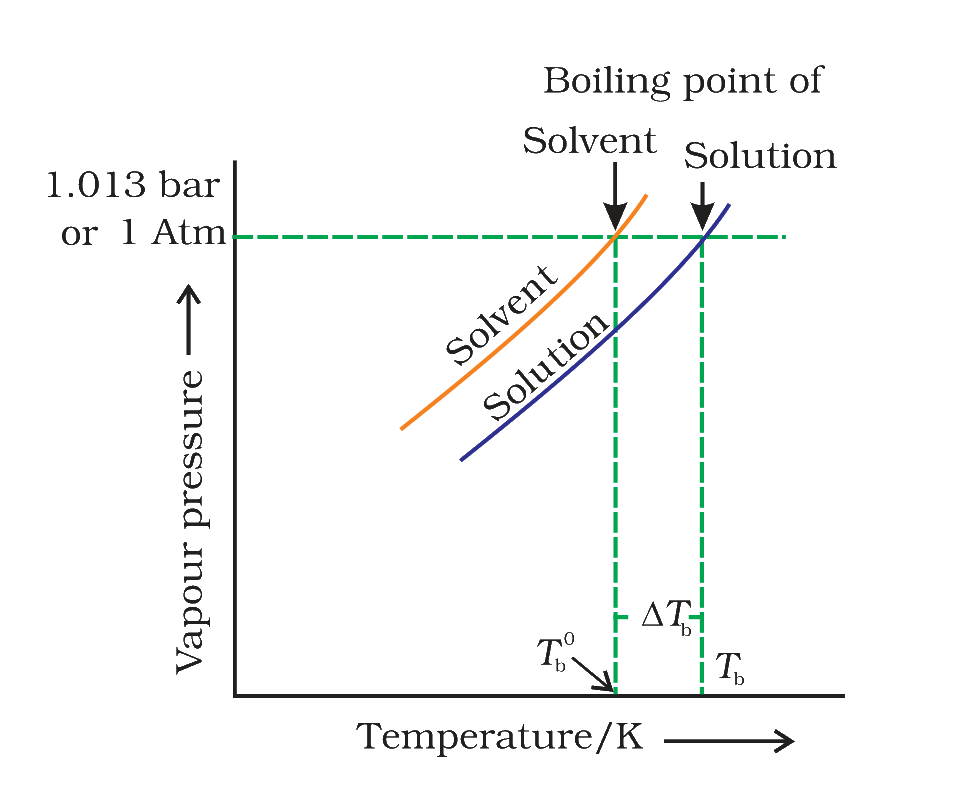
Vapour pressure against temperature for solvent and solution

A second solution of the same solute in the same solvent is more concentrated than the solution shown. Where would its vapour pressure curve lie, and at what temperature would it boil at 1.013 bar?

Answer & explanation+

Correct answer: option 2

The correct answer is Option (2) → Below the curve of the solution shown; it would boil above Tb.

The decrease in the vapour pressure of the solvent depends on the quantity of non-volatile solute present. A liquid boils when its vapour pressure becomes equal to the atmospheric pressure, 1.013 bar.

  • Position of the curve — below the solution curve. More solute lowers the vapour pressure more, so at every temperature the more concentrated solution has a lower vapour pressure than the solution shown.

  • Boiling point — above Tb. In the figure the solution curve reaches the 1.013 bar line at Tb. A curve lying lower reaches that line only at a higher temperature, so ΔTb is larger.

Why the other options are incorrect

Option (1) Above the curve of the solution shown; it would boil between Tb0 and Tb. — Incorrect. A curve above the one shown would mean a smaller lowering of vapour pressure, which fits a more dilute solution, not a more concentrated one.

Option (3) On the same curve as the solution shown; it would boil at Tb. — Incorrect. The lowering of vapour pressure depends on the quantity of solute, so solutions of different concentration have different curves.

Option (4) Above the curve of the pure solvent; it would boil below Tb0. — Incorrect. A non-volatile solute always lowers the vapour pressure, so no such solution lies above the solvent curve or boils below the boiling point of the pure solvent.

NCERT (2026-27 edition):
1.4.3 Vapour Pressure of Solutions of Solids in Liquids – “The decrease in the vapour pressure of solvent depends on the quantity of non-volatile solute present in the solution, irrespective of its nature.”

1.6.2 Elevation of Boiling Point – “The vapour pressure of a liquid increases with increase of temperature. It boils at the temperature at which its vapour pressure is equal to the atmospheric pressure. … For example, the vapour pressure of an aqueous solution of sucrose is less than 1.013 bar at 373.15 K. In order to make this solution boil, its vapour pressure must be increased to 1.013 bar by raising the temperature above the boiling temperature of the pure solvent (water).”

Fig. 1.7

Fig. 1.7: The vapour pressure curve for solution lies below the curve for pure water. The diagram shows that ΔTb denotes the elevation of boiling point of a solvent in solution.

Advertisement

Practise more on Physical: Solutions

Chapter-wise mocks on the real NTA exam screen, with solutions and your rank. Your first mocks are free.

Start free mocks →

Advertisement

Next questions

  1. Fill in the blank with the most appropriate phrasal verb:Offered only a small raise, the bank staff union ______ for a full wage revision a…English · Grammar: Phrasal Verb
  2. 'Income and employment theory' is the other name for which branch of Economics?General Aptitude Test · General Knowledge
  3. Which of the answer figures (1), (2), (3) and (4) completes the figure matrix?General Aptitude Test · Non-Verbal Reasoning
  4. The binary liquid mixtures which show negative deviation from Raoult’s law are :(A) n-hexane and n-heptane(B) phenol and acetone(C) Ethanol…Chemistry · Physical: Solutions
  5. The period of oscillation T of a pendulum of length l at a place of acceleration due to gravity g is given by T=2 π √(l/g). If the calculat…Maths. Section B1 · Applications of Derivatives
  6. Read the passage and answer the question.The base of a pyramid is broad and it narrows towards the apex. One gets a similar shape whether o…Biology · Ecosystem
  7. Which of the following international body has provided a framework for domestic laws on international arbitration?Legal Studies · International Context
  8. Equivalent energy of mass equal to 1 a.m.u. isPhysics · Nuclei
  9. In which year was the Battle of Saragarhi fought?General Aptitude Test · General Knowledge
  10. Which type of synapse involves in the direct flow of electrical current from one neuron to another?Biology · Neural Control and Coordination