The properties which depend on the number of solute particles irrespective of their nature relative to the total numbers of particles in the solution are called colligative properties. These are relative lowering of vapour pressure of the solvent, depression of freezing point of the solvent, elevation of boiling point of the solvent and osmotic pressure of the solution. All of these properties help in calculating the observed molar mass of the solute. Determination of osmotic pressure is considered best for the determination of molecular mass of the solute.
The binary liquid mixtures which show negative deviation from Raoult’s law are :
(A) n-hexane and n-heptane
(B) phenol and acetone
(C) Ethanol and acetone
(D) Chloroform and acetone
(E) Benzene and toluene
Choose the correct answer from the options given below :
Answer & explanation
Correct answer: option 3
The correct answer is Option (3) → (B) and (D) only
A solution shows negative deviation from Raoult’s law when the A–B attractions are stronger than the A–A and B–B attractions. The molecules escape less easily, so the vapour pressure is lower than predicted (ΔmixH < 0). This usually happens when the two components form hydrogen bonds with each other. Positive deviation is the reverse case: A–B attractions weaker, vapour pressure higher.
(A) n-hexane and n-heptane — Incorrect. Two similar non-polar alkanes; the A–B forces equal the A–A and B–B forces, so the solution is nearly ideal.
(B) phenol and acetone — Correct. The phenolic O–H forms a hydrogen bond with the C=O oxygen of acetone, an attraction stronger than those in the pure liquids.
(C) Ethanol and acetone — Incorrect. Acetone molecules break some of the hydrogen bonds between ethanol molecules, so the attractions are weakened: positive deviation.
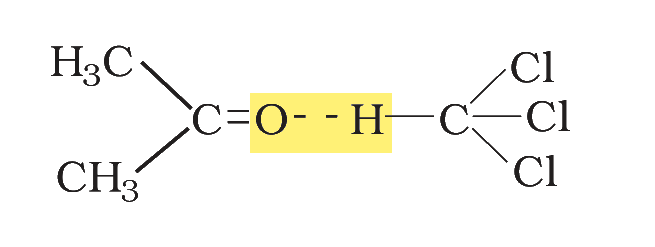
(D) Chloroform and acetone — Correct. The H of \( \ce{CHCl3} \) (made acidic by three Cl atoms) forms a hydrogen bond with the oxygen of acetone, lowering the vapour pressure.
(E) Benzene and toluene — Incorrect. Two similar non-polar aromatic liquids; this mixture is the standard example of a nearly ideal solution.
NCERT (2026-27 edition):
Non-ideal Solutions – “… In case of negative deviations from Raoult’s law, the intermolecular attractive forces between A-A and B-B are weaker than those between A-B and leads to decrease in vapour pressure resulting in negative deviations. An example of this type is a mixture of phenol and aniline. In this case the intermolecular hydrogen bonding between phenolic proton and lone pair on nitrogen atom of aniline is stronger than the respective intermolecular hydrogen bonding between similar molecules. Similarly, a mixture of chloroform and acetone forms a solution with negative deviation from Raoult’s law. This is because chloroform molecule is able to form hydrogen bond with acetone molecule as shown.”