Consider the following reaction
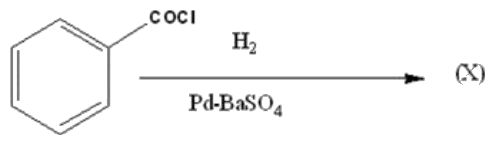
Product (X) is
Answer & explanation
Correct answer: option 2
The correct answer is Option (2) → C6H5CHO
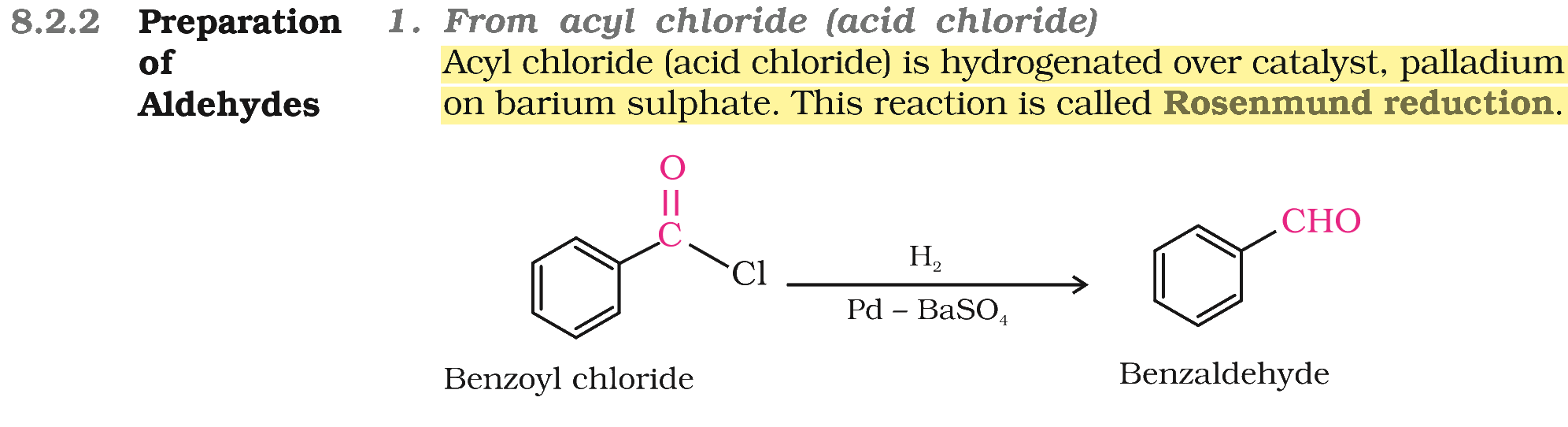
An acyl chloride can be reduced to an aldehyde with hydrogen over palladium supported on barium sulphate. This is the Rosenmund reduction. Pd on \( \ce{BaSO4} \) is a poisoned (partly deactivated) catalyst: it is active enough to replace the Cl by H, but too weak to reduce the aldehyde further to an alcohol.
\( \displaystyle \ce{R-COCl + H2} \xrightarrow{\ce{Pd-BaSO4}} \ce{R-CHO + HCl} \)
The starting compound is benzoyl chloride, \( \ce{C6H5COCl} \).
So the product (X) is benzaldehyde, C6H5CHO.
Why the other options are incorrect
Option (1) C6H5OH — Incorrect. Phenol would need the whole –COCl group to be replaced by –OH; hydrogenation does not do this.
Option (3) C6H5COCH3 — Incorrect. Acetophenone needs a methyl group to be added, for example by treating the acyl chloride with dimethylcadmium.
\( \displaystyle \ce{2C6H5COCl + (CH3)2Cd -> 2C6H5COCH3 + CdCl2} \)
Option (4) C6H5Cl — Incorrect. Chlorobenzene would need loss of the C=O carbon; no carbon is lost in Rosenmund reduction.
NCERT (2026-27 edition):
Preparation of Aldehydes