The conductivity of an electrolytic solution is measured with a conductivity cell, which has two electrodes a fixed distance l apart, each with an area of cross-section A. The resistance R of the cell is given by R = ρl/A = l/(κA), where ρ is the resistivity and κ the conductivity of the solution.
The quantity l/A is constant for a given cell; it is denoted by G* and is called the cell constant. It is found by measuring the resistance of the cell filled with a KCl solution whose conductivity is known accurately at various concentrations: G* = l/A = Rκ.
The molar conductivity of a solution, Λm, is its conductivity divided by its molar concentration (Λm = κ/c). Its SI unit is S m2 mol−1 when c is expressed in mol m−3. Conductivity always decreases with decrease in concentration, for both strong and weak electrolytes, because the number of ions per unit volume that carry the current in the solution decreases.
Match List-I with List-II.
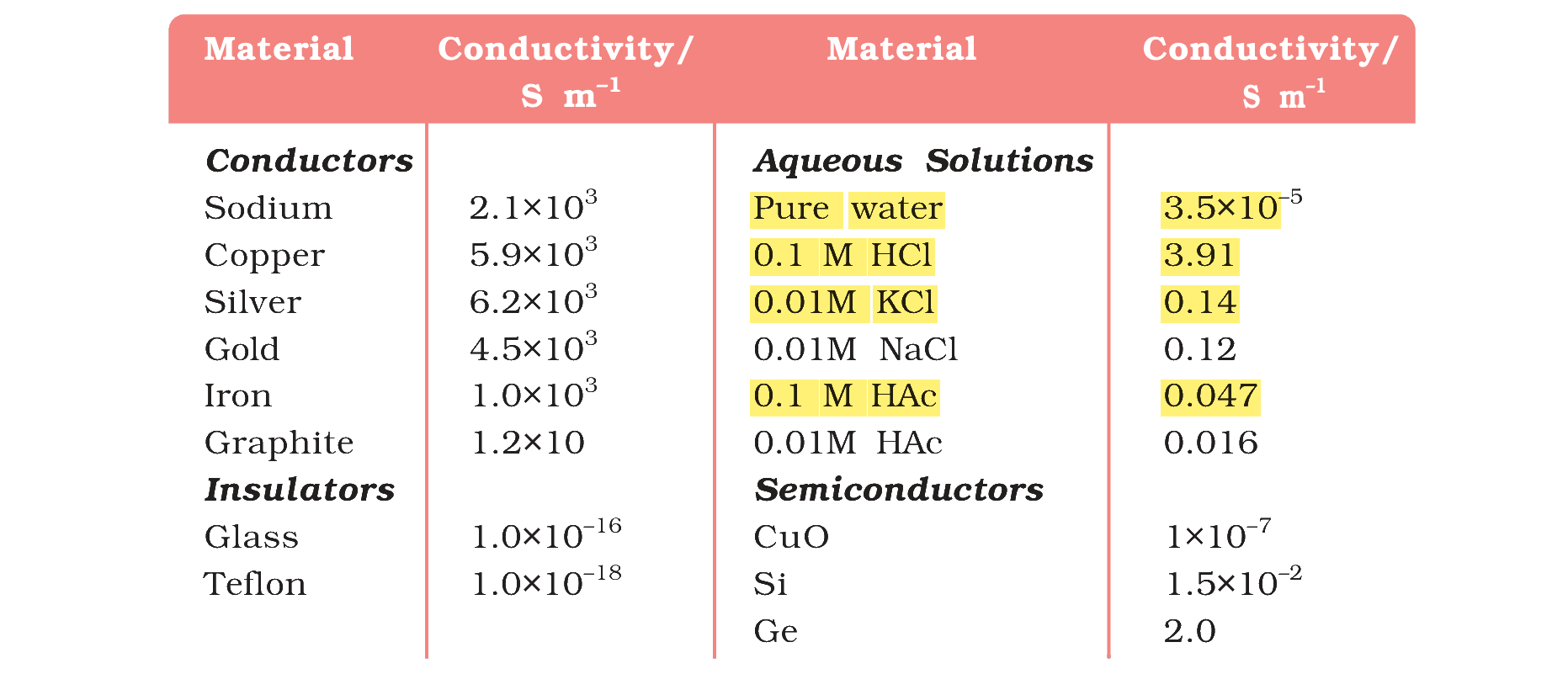
| List-I (Aqueous solution / liquid) | List-II (Conductivity at 298.15 K, in S m−1) |
|---|---|
| (A) 0.1 M HCl | (I) 0.047 |
| (B) 0.01 M KCl | (II) 3.5 × 10⁻⁵ |
| (C) 0.1 M acetic acid | (III) 3.91 |
| (D) Pure water | (IV) 0.14 |
Choose the correct answer from the options given below:
Answer & explanation
Correct answer: option 4
The correct answer is Option (4) → A-III, B-IV, C-I, D-II
The conductivity of an ionic solution depends on the number of ions it holds per unit volume, and so on the nature of the electrolyte (strong or weak) and its concentration.
(A) 0.1 M HCl — This matches (III) 3.91. HCl is a strong electrolyte, fully dissociated, and here it is at the highest concentration of the strong electrolytes, so it has the most ions and the highest conductivity.
(B) 0.01 M KCl — This matches (IV) 0.14. KCl is also a strong electrolyte, but the solution is ten times more dilute, so it has far fewer ions per unit volume.
(C) 0.1 M acetic acid — This matches (I) 0.047. Acetic acid is a weak electrolyte with a low degree of dissociation at higher concentrations, so even at 0.1 M it gives fewer ions than 0.01 M KCl.
(D) Pure water — This matches (II) 3.5 × 10⁻⁵. Water has only about 10−7 M of H+ and OH− ions, which give it a very low conductivity.
NCERT (2026-27 edition):
2.4 Conductance of Electrolytic Solutions – “…We already know that even very pure water has small amounts of hydrogen and hydroxyl ions (~10–7M) which lend it very low conductivity (3.5 × 10⁻⁵ S m–1). When electrolytes are dissolved in water, they furnish their own ions in the solution hence its conductivity also increases. The conductance of electricity by ions present in the solutions is called electrolytic or ionic conductance. The conductivity of electrolytic (ionic) solutions depends on: (i) the nature of the electrolyte added … (iv) concentration of the electrolyte”
2.4.2 Variation of Conductivity and Molar Conductivity with Concentration – “Weak electrolytes like acetic acid have lower degree of dissociation at higher concentrations…”
Table 2.2: The values of Conductivity of some Selected Materials at 298.15 K