Hinsberg's reagent can distinguish which of the following set of compounds?
Answer & explanation
Correct answer: option 1
The correct answer is Option (1) → Primary, secondary and tertiary amines
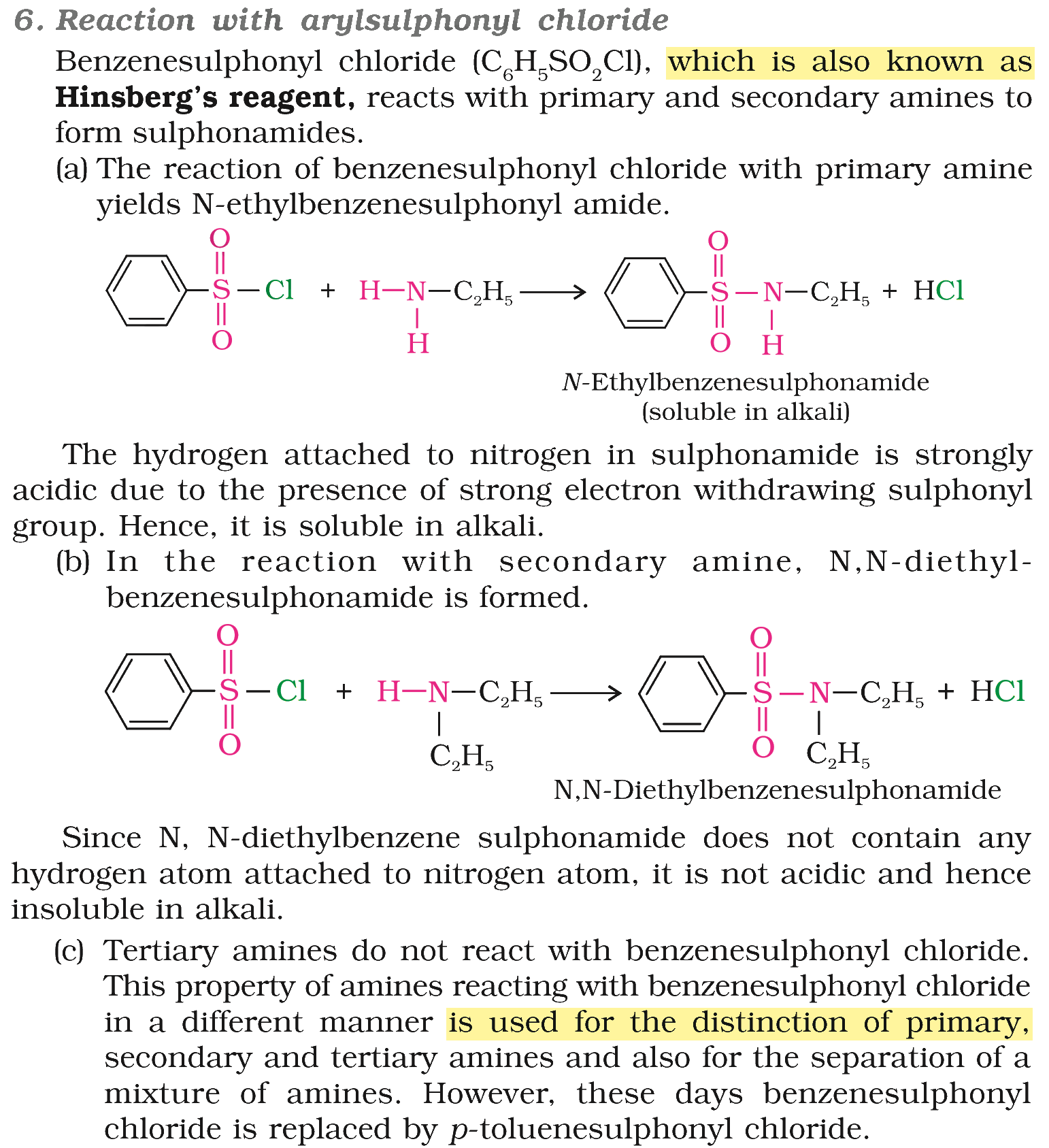
Hinsberg’s reagent is benzenesulphonyl chloride, \( \ce{C6H5SO2Cl} \). It reacts only with amines that carry a hydrogen atom on nitrogen, so the three classes of amine give three different results.
So Hinsberg’s reagent distinguishes primary, secondary and tertiary amines.
Why the other options are incorrect
Option (2) Aldehydes and Ketones — Incorrect. These are distinguished by Tollens’ test or Fehling’s test, which only aldehydes give.
Option (3) Primary, secondary and tertiary alcohols — Incorrect. These are distinguished by the Lucas test (conc. HCl + \( \ce{ZnCl2} \)): tertiary alcohols turn turbid at once, secondary in a few minutes, primary not at room temperature.
Option (4) Alcohols and phenols — Incorrect. Phenols give a violet colour with neutral FeCl3, and alcohols do not.
NCERT (2026-27 edition):
Reaction with Arylsulphonyl Chloride