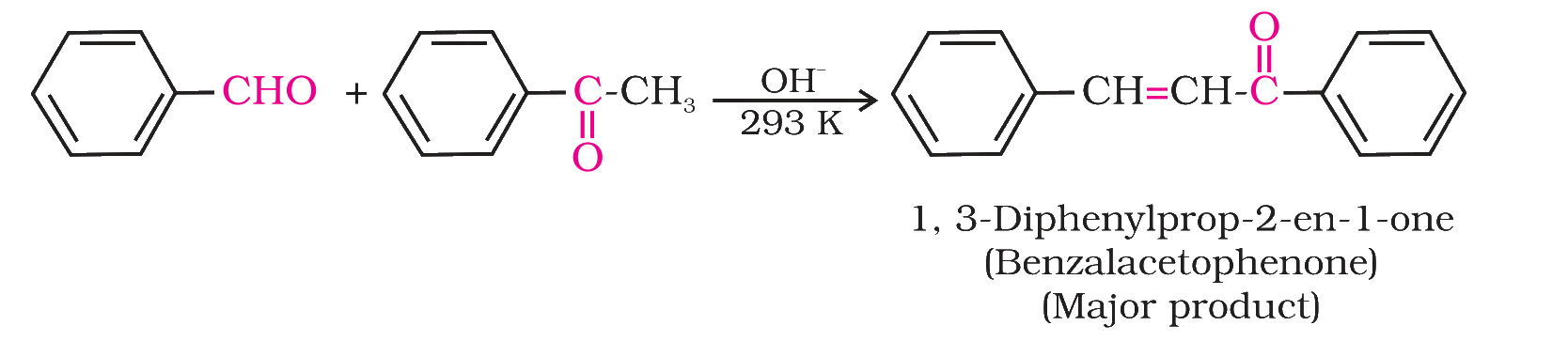
Benzaldehyde is treated with acetophenone in the presence of a base (\( \ce{OH-} \)) at 293 K. Which of the following is the major product?
Answer & explanation
Correct answer: option 2
The correct answer is Option (2) → 1,3-Diphenylprop-2-en-1-one
This is a cross aldol condensation in which a ketone is one component.
Step 1 – Carbanion from acetophenone: acetophenone has α-hydrogens on its CH3 group, so the base removes one of them. Benzaldehyde has no α-hydrogen, so it only accepts the attack.
Step 2 – Addition and loss of water: the carbanion adds to the carbonyl carbon of benzaldehyde. The β-hydroxy ketone formed loses water at once to give an α,β-unsaturated ketone, benzalacetophenone:
\( \displaystyle \ce{C6H5CHO + CH3COC6H5} \xrightarrow[\text{293 K}]{\ce{OH-}} \ce{C6H5CH=CHCOC6H5 + H2O} \)
Final product: benzalacetophenone, C6H5CH=CHCOC6H5, is 1,3-diphenylprop-2-en-1-one (Option 2):
the C6H5CO group of acetophenone stays, so the product is a ketone;
the C=C bond comes from the loss of water in Step 2;
the second phenyl group, at C-3, comes from benzaldehyde.
Why the other options are incorrect
Option (1) Benzyl alcohol and a benzoate salt — Incorrect. These are the Cannizzaro products of benzaldehyde, formed on heating with concentrated alkali. Here the carbanion from acetophenone reacts with benzaldehyde instead.
Option (3) 1,3-Diphenylpropan-1-one — Incorrect. This ketone has no C=C bond. The condensation step loses water and creates a C=C bond, and no reducing agent is present to remove it.
Option (4) 3-Phenylprop-2-enal — Incorrect. This aldehyde would need ethanal as the partner of benzaldehyde. With acetophenone as the partner, the product keeps the C6H5CO group, so it is a ketone.
NCERT (2026-27 edition):
8.4 Chemical Reactions – “(ii) Cross aldol condensation: When aldol condensation is carried out between two different aldehydes and / or ketones, it is called cross aldol condensation.”
“Ketones can also be used as one component in the cross aldol reactions.”