What are the suitable conditions for the Cannizzaro reaction?
Answer & explanation
Correct answer: option 4
The correct answer is Option (4) → The compound doesn't have α-H and a concentrated base.
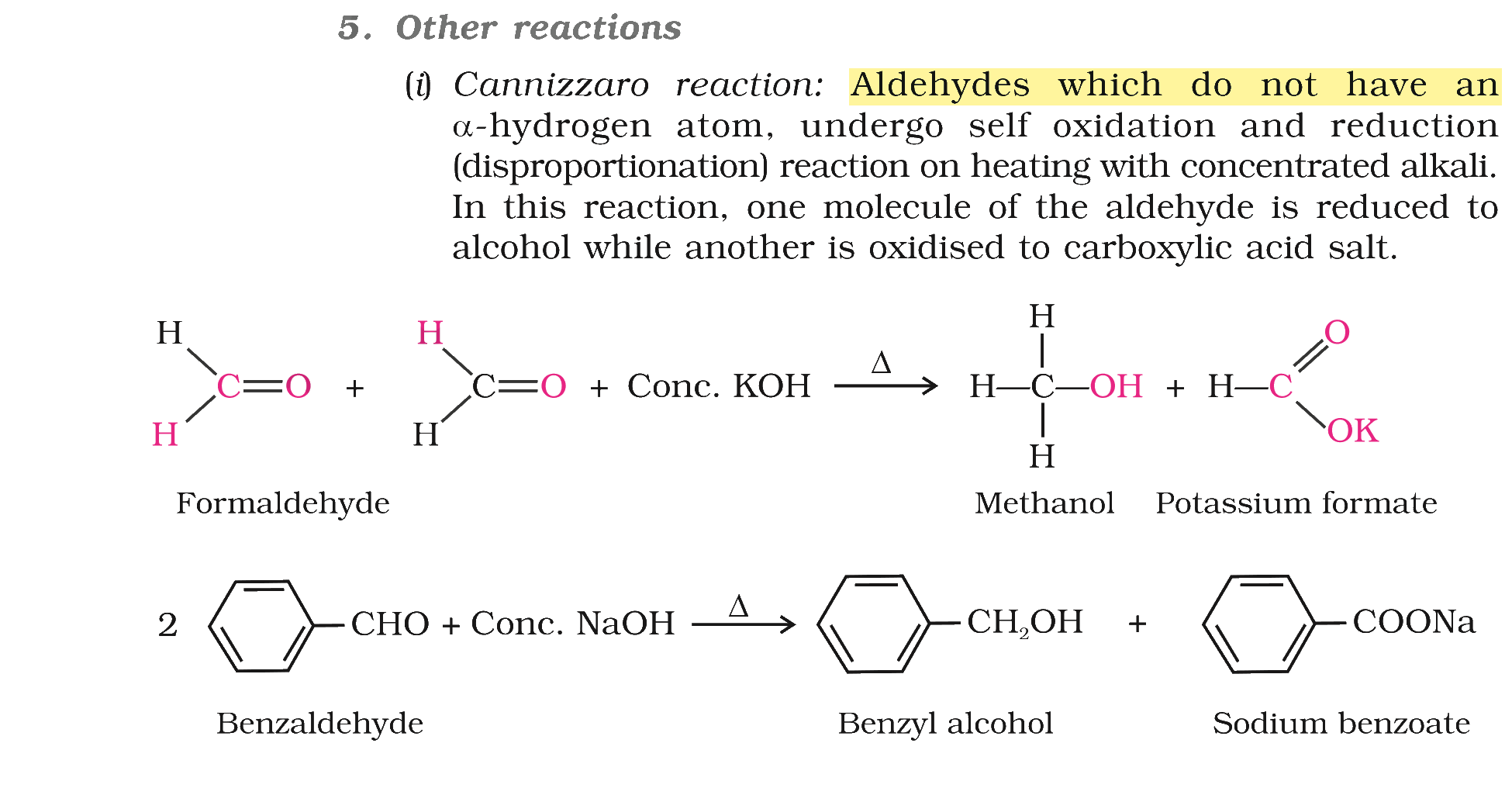
The Cannizzaro reaction is a self oxidation–reduction (disproportionation) of an aldehyde: one molecule is reduced to an alcohol while another is oxidised to the salt of a carboxylic acid. It needs two conditions:
The aldehyde has no α-hydrogen, for example HCHO or benzaldehyde.
It is heated with a concentrated alkali.
An aldehyde or ketone that does have an α-hydrogen reacts in another way. With a dilute base it gives the aldol, which loses water on heating:
\( \displaystyle \ce{2CH3CHO} \xrightarrow{\text{dil. NaOH}} \ce{CH3CH(OH)CH2CHO} \xrightarrow{\Delta} \ce{CH3CH=CHCHO + H2O} \)
Why the other options are incorrect
Option (1) The compound has α -H and a dilute base. — Incorrect. These are the conditions for the aldol reaction, not the Cannizzaro reaction.
Option (2) The compound doesn't have α-H and a dilute base. — Incorrect. The absence of α-H is right, but a dilute base is not enough; the Cannizzaro reaction needs a concentrated alkali.
Option (3) The compound has α-H and a concentrated base. — Incorrect. A compound with an α-hydrogen forms a carbanion with the base and undergoes aldol-type reactions instead.
NCERT (2026-27 edition):
Other Reactions