Arrange the following energies in increasing order of their magnitudes.
A. Energy required to set an electron free in an n-type semiconductor made from Si doped with arsenic
B. Band gap energy of a pure Ge semiconductor
C. Energy required to set an electron free in an n-type semiconductor made from Ge doped with antimony
D. Band gap energy of a pure Si semiconductor.
Choose the correct answer from the options given below:
Answer & explanation
Correct answer: option 4
The correct answer is Option (4) → C, A, B, D
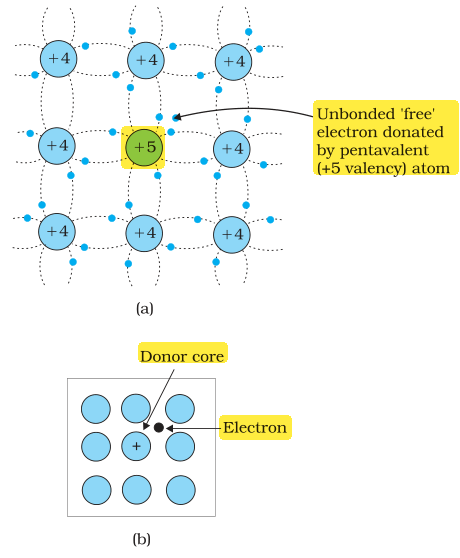
In an n-type semiconductor the fifth valence electron of the donor atom is only loosely bound, so the donor ionisation energy is very small, far smaller than the band gap of the pure semiconductor. The binding is weaker in germanium than in silicon, and the band gap of germanium is smaller than that of silicon.
(C) Energy required to set an electron free in an n-type semiconductor made from Ge doped with antimony: about 0.01 eV
(A) Energy required to set an electron free in an n-type semiconductor made from Si doped with arsenic: about 0.05 eV
(B) Band gap energy of a pure Ge semiconductor: about 0.7 eV
(D) Band gap energy of a pure Si semiconductor: about 1.1 eV
So the increasing order is C, A, B, D.
NCERT (2026-27):
n-type Semiconductor – “Suppose we dope Si or Ge with a pentavalent element as shown in Fig. 14.7. … As a result the ionisation energy required to set this electron free is very small and even at room temperature it will be free to move in the lattice of the semiconductor. For example, the energy required is ~ 0.01 eV for germanium, and 0.05 eV for silicon, to separate this electron from its atom. This is in contrast to the energy required to jump the forbidden band (about 0.72 eV for germanium and about 1.1 eV for silicon) at room temperature in the intrinsic semiconductor.”