
What is the shape of the wavefront of a beam of parallel rays?
Answer & explanation
Correct answer: option 3
The correct answer is Option (3) → Planar
Rays are always normal to the wavefront, so the shape of the wavefront follows from the directions of the rays.
Option (1) Spherical — Incorrect. The normals to a spherical wavefront all pass through its centre, so its rays diverge from or converge to a point. They are not parallel.
Option (2) Cylindrical — Incorrect. The normals to a cylindrical surface spread out from its axis. So the rays of such a wavefront would spread out too. They would not stay parallel.
Option (3) Planar — Correct. Parallel rays all point the same way, and the only surface normal to all of them is a plane. Light from a very distant source behaves this way. A small portion of its spherical wavefront is nearly a plane wave.
NCERT (2026-27):
Huygens Principle – “If we have a point source emitting waves uniformly in all directions, then the locus of points which have the same amplitude and vibrate in the same phase are spheres and we have what is known as a spherical wave … At a large distance from the source, a small portion of the sphere can be considered as a plane and we have what is known as a plane wave …”
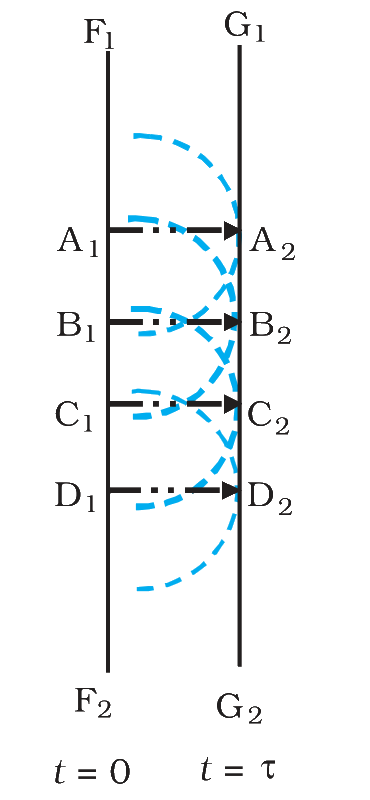
Fig. 10.3: Huygens geometrical construction for a plane wave propagating to the right. F1F2 is the plane wavefront at t = 0 and G1G2 is the wavefront at a later time τ. The lines A1A2, B1B2 … etc., are normal to both F1F2 and G1G2 and represent rays.