
A uniform magnetic field is directed along the positive x-axis. A charged particle enters this field with its velocity at an angle of \( 30^\circ \) to the field. What is the path traced by the particle?
Answer & explanation
Correct answer: option 3
The correct answer is Option (3) → A helical path
The magnetic force \( q\,(\vec{v}\times\vec{B}) \) acts only on the component of velocity perpendicular to the field. With the velocity at \( 30^\circ \) to the field, it has a component \( v\cos30^\circ \) along the x-axis (along \( \vec{B} \)) and a component \( v\sin30^\circ \) perpendicular to it.
Option (1) An arbitrary trajectory — Incorrect. In a uniform field the motion follows a fixed pattern. The particle drifts steadily along the field and also goes round a circle of constant radius. So the path is a regular curve.
Option (2) A circular path — Incorrect. A circle is traced only when the velocity is perpendicular to the field. Here the component \( v\cos30^\circ \) along the field is not zero. It carries the particle forward along the x-axis.
Option (3) A helical path — Correct. The component \( v\cos30^\circ \) along the field stays unchanged. The component \( v\sin30^\circ \) gives circular motion in the plane perpendicular to the field. The two together make the particle move along a helix whose axis is along the x-axis.
Option (4) Concentric circles — Incorrect. The speed and the field stay constant, so the radius of the circular part does not change from turn to turn. The particle also moves along the field, so it does not stay in one plane.
NCERT (2026-27):
Motion in a Magnetic Field – “If velocity has a component along B, this component remains unchanged as the motion along the magnetic field will not be affected by the magnetic field. The motion in a plane perpendicular to B is as before a circular one, thereby producing a helical motion (Fig. 4.6).”
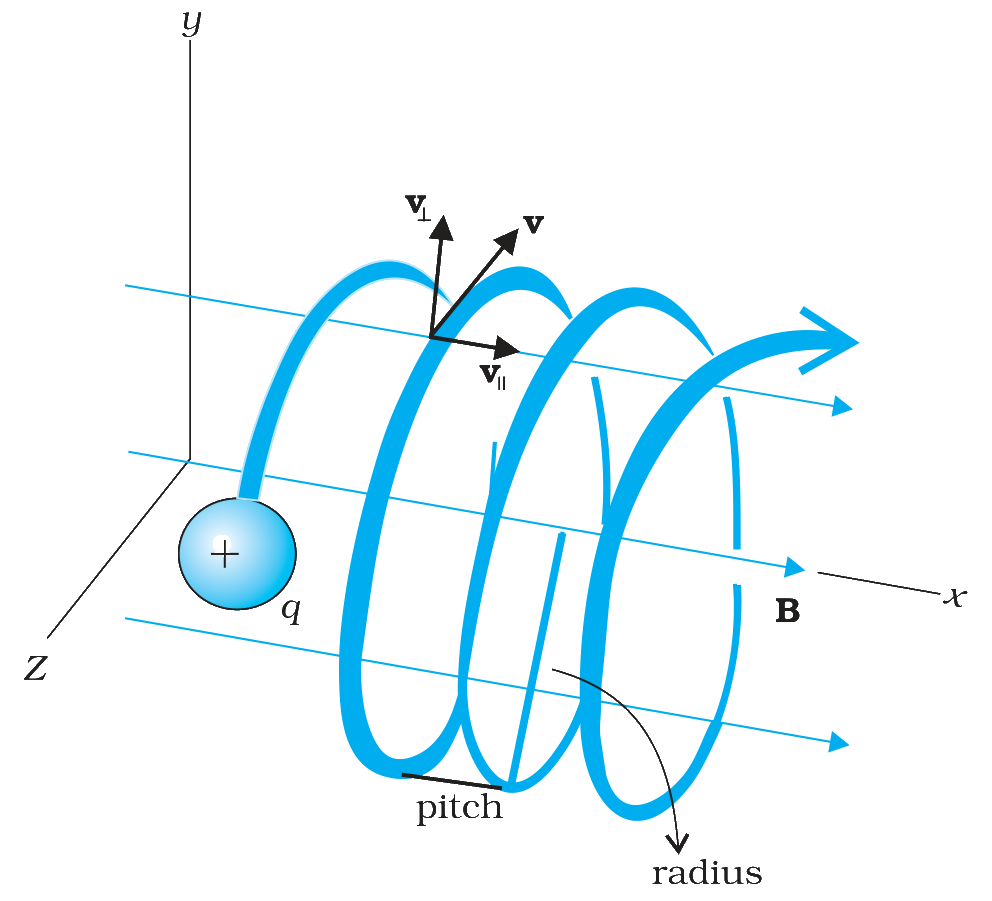
Fig. 4.6: Helical motion