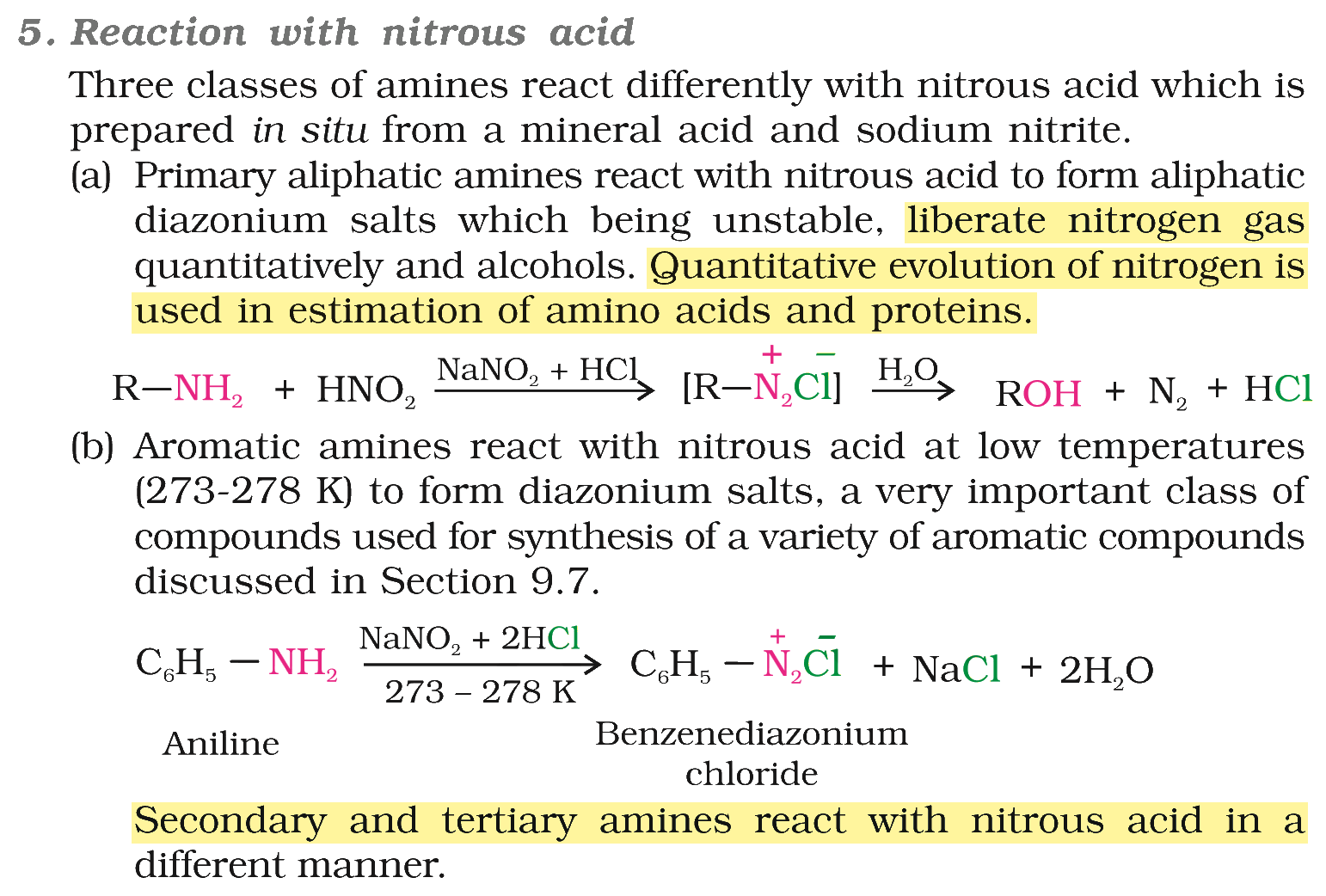
Identify the isomer corresponding to the molecular formula, C4H11N, which will not liberate nitrogen gas on treatment with nitrous acid. This quantitative evolution of nitrogen is used in estimation of amino acids and proteins.
Answer & explanation
Correct answer: option 2
The correct answer is Option (2) → Diethylamine
The three classes of amines react differently with nitrous acid, which is made in situ from sodium nitrite and dilute HCl:
\( \displaystyle \ce{NaNO2 + HCl -> HNO2 + NaCl} \)
A primary aliphatic amine forms an unstable aliphatic diazonium salt, which at once breaks down to the alcohol and nitrogen gas. A secondary amine instead gives a yellow oily N-nitrosamine, and no nitrogen is evolved:
\( \displaystyle \ce{R-NH2 + HNO2} \xrightarrow{\ce{NaNO2}\text{ + }\ce{HCl}} \ce{R-OH + N2 ^ + H2O} \)
\( \displaystyle \ce{(C2H5)2NH + HNO2} \xrightarrow{\ce{NaNO2}\text{ + }\ce{HCl}} \underset{\text{N-nitrosodiethylamine}}{\ce{(C2H5)2N-N=O}} + \ce{H2O} \)
Option (1) Neobutylamine — Liberates nitrogen. Neobutylamine is not a standard name; any butylamine, C4H9–NH2, is a primary amine and liberates nitrogen with nitrous acid.
Option (2) Diethylamine — Does not liberate nitrogen. \( \ce{(C2H5)2NH} \) is the only secondary amine of formula \( \ce{C4H11N} \) here; it gives N-nitrosodiethylamine instead.
Option (3) Isobutylamine — Liberates nitrogen. \( \ce{(CH3)2CHCH2NH2} \) (2-methylpropan-1-amine) is a primary amine.
Option (4) Butan-2-amine — Liberates nitrogen. \( \ce{CH3CH(NH2)CH2CH3} \) has its –\( \ce{NH2} \) on a secondary carbon, but it is still a primary amine (only one carbon on nitrogen).
NCERT (2026-27 edition):
Reaction with Nitrous Acid