
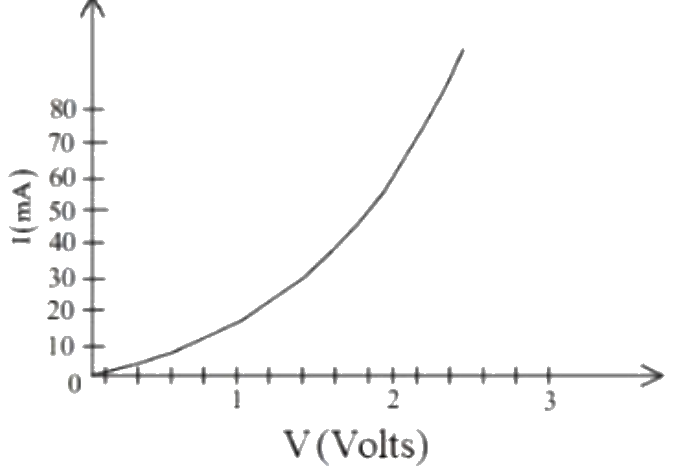
The I-V characteristics of a silicon diode under forward bias is shown in the figure given below. The diode resistance at \( 2.0 \) V is
Answer & explanation
Correct answer: option 3
The correct answer is Option (3) → \( 20\,\Omega \)
The resistance of a diode at a point on its characteristic is taken as the dynamic resistance: the ratio of a small change in voltage to the corresponding change in current near that point, \( r_d = \Delta V/\Delta I \). Because the curve is non-linear, this resistance changes from point to point.
Readings taken from the graph near 2.0 V:
\( \text{At } V = 1.5\,\mathrm{V}: I \approx 35\,\mathrm{mA} \)
\( \text{At } V = 2.0\,\mathrm{V}: I \approx 60\,\mathrm{mA} \)
\( \Delta V = 2.0 - 1.5 = 0.5\,\mathrm{V} \)
\( \Delta I = 60 - 35 = 25\,\mathrm{mA} = 25\times10^{-3}\,\mathrm{A} \)
\( \displaystyle r_d = \frac{\Delta V}{\Delta I} = \frac{0.5\,\mathrm{V}}{25\times10^{-3}\,\mathrm{A}} = 20\,\Omega \)
Note: The question does not state whether the static (dc) resistance or the dynamic resistance is meant. If the resistance is taken as the static value \( V/I \) at the point, the reading \( I \approx 60\,\mathrm{mA} \) at 2.0 V gives \( R = 2.0\,\mathrm{V}/0.060\,\mathrm{A} \approx 33\,\Omega \), which is Option (4). So under that reading Option (4) is also correct. When a diode question asks for the resistance at a point of the I-V curve, take it as the dynamic resistance \( \Delta V/\Delta I \) near that point; use V/I only when the dc (static) resistance is asked.
Note: NTA picked this question from an NCERT (2026-27) example and changed the figures. Do not ignore NCERT while practising numericals.
NCERT (2026-27):
p-n Junction Diode Under Reverse Bias – …
