
CUETMOCK
  • Pricing
  • Mentors
Log inStart freeStart free mocks→

First test, then trust

Try a free CUET mock test.

Join 5,00,000+ students who rehearsed exam day on the exact NTA screen before sitting CUET. On the web and on Android.

Start free mocks →Get the Android app
CUETMOCK

India's #1 CUET Mock Test Platform. Original NCERT-based questions on the exact NTA exam screen — trusted by 5,00,000+ students since CUET 2022.

Get it onGoogle PlayScan to download the CUETMOCK app

Mock tests

  • CUET mock test series
  • Commerce mocks
  • Humanities (Arts) mocks
  • Science mocks
  • Languages & GAT mocks
  • Free practice questions
  • Pricing

Resources

  • CUET exam guide
  • CUET syllabus
  • Universities accepting CUET
  • Expert blogs
  • News & notifications
  • Webinars & counselling
  • CUET score calculator
  • How we estimate your rank
  • FAQs

Company

  • About us
  • Our leadership & team
  • Our toppers
  • Mentors
  • For schools
  • Contact us
  • Terms
  • Privacy
  • Refund policy

Talk to us

+91 7696 6630 56info@cuetmock.comWhatsApp us

Our other platforms

  • JEE Mock — For IIT-JEE aspirants
  • NEET Mock — For NEET aspirants

Newsletter

Exam updates, study material and offers — no spam.

© 2026 NYC Ventures Pvt. Ltd.

701-702, Royal Business Park, Zirakpur, Punjab - 140603

  • Terms of use
  • Privacy policy
  • Refund policy
  • Contact us

iCUETMOCK is an independent preparation platform, not affiliated with the National Testing Agency (NTA). Always check exam details on the official NTA website.

  • Home
  • Mock tests
  • CUET guide
  • Pricing
  • Log in
Home/Practice questions/Chemistry
ChemistryInorganic: D and F Block Elements

Select the pair of d block metals that do not exhibit variable oxidat…

d-Block elements

The d-block of the periodic table contains the elements in which the d orbitals are progressively filled in each of the four long periods. The d-block elements are also known as transition metals. Originally, the name transition metals was derived from the fact their chemical properties were transitional between those of s- and p-block elements. They show numerous oxidation states. All the transition elements exhibit typical metallic properties such as high tensile strength, ductility, malleability, thermal and electrical conductivity. Another important property of transition metals is their catalytic activity. Transition metals generally have high melting and boiling points. Many d-block elements are colored.

Select the pair of d block metals that do not exhibit variable oxidation states:

Answer & explanation+

Correct answer: option 3

The correct answer is Option (3) → Sc, Zn

Transition elements show variable oxidation states because the energies of their (n−1)d and ns orbitals are very close. After the ns electrons are lost, one or more d electrons can also be removed, giving several stable oxidation states. An element shows only one oxidation state when losing any other number of electrons does not give a stable arrangement:

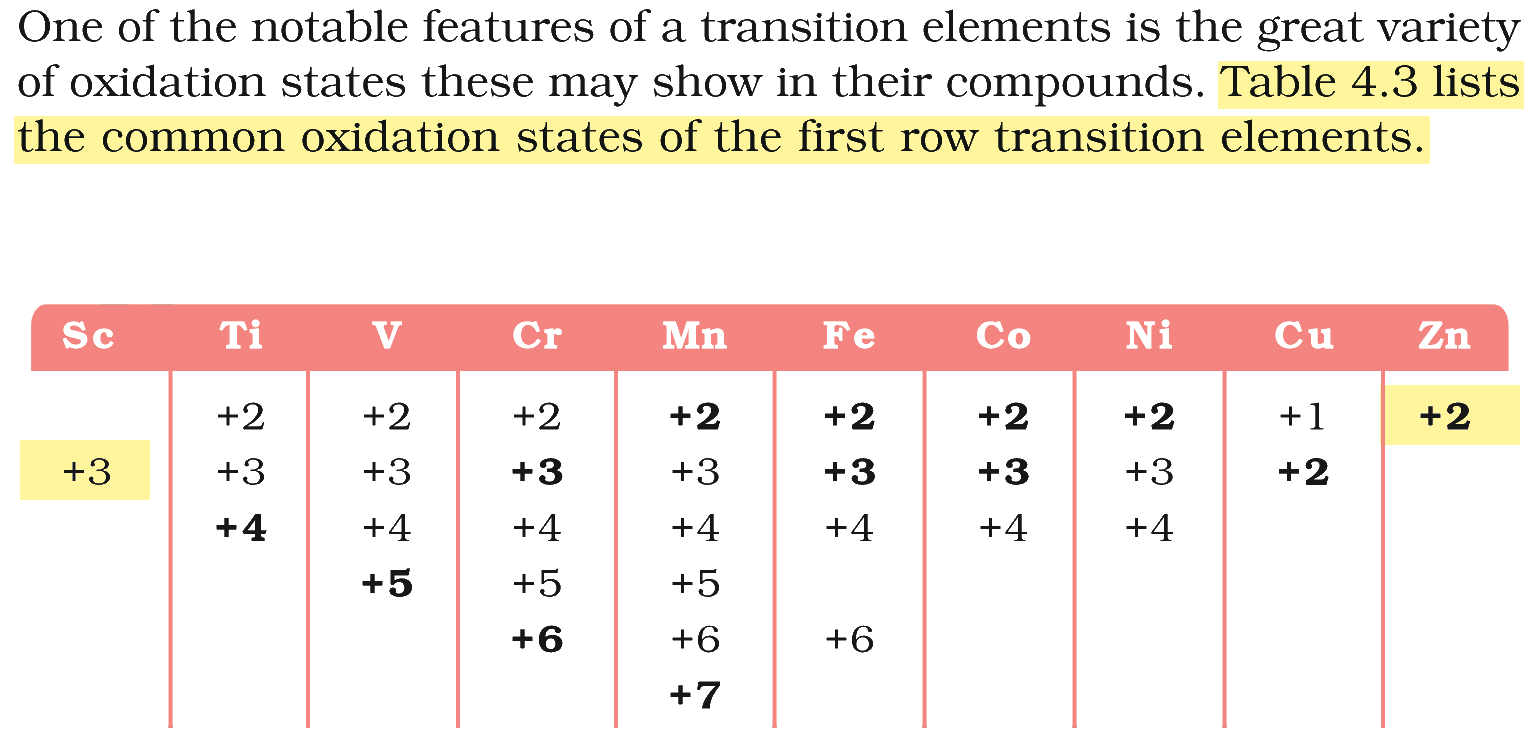
  • Sc (Z = 21, [Ar]3d14s2): loses all three outer electrons to reach the stable argon configuration, so it shows only +3.

  • Zn (Z = 30, [Ar]3d104s2): loses only the two 4s electrons; the full 3d10 set is not used in bonding, so it shows only +2.

  • Ti (Z = 22, [Ar]3d24s2): shows +2, +3 and +4.

  • Cr (Z = 24, [Ar]3d54s1): shows +2, +3 and +6, and also +4 and +5.

  • Cu (Z = 29, [Ar]3d104s1): shows +1 and +2.

  • Option (1) Cr, Cu — Both show variable oxidation states. Chromium shows +2 to +6 and copper shows +1 and +2.

  • Option (2) Sc, Ti — Ti shows variable oxidation states. Titanium shows +2, +3 and +4 (only Sc is fixed at +3).

  • Option (3) Sc, Zn — Neither shows variable oxidation states. Sc shows only +3 and Zn only +2.

  • Option (4) Cu, Zn — Cu shows variable oxidation states. Copper shows +1 and +2 (only Zn is fixed at +2).

NCERT (2026-27 edition):
Oxidation States
Textbook extract

Note: The same/similar question has been asked in different years by NTA as per the details given below:

20262025202420232022
14-05 S2
11-05 S1
––––

Advertisement

Practise more on Inorganic: D and F Block Elements

Chapter-wise mocks on the real NTA exam screen, with solutions and your rank. Your first mocks are free.

Start free mocks →

Advertisement

Next questions

  1. What will be the increasing order of basic strength of the following compounds? C_2H_5NH_2, \ (C_2H_5)_2NH, \ (C_2H_5)_3N, \ C_6H_5NH_2Chemistry · Organic: Amines
  2. Match List-I with List-IIList-IDissolution TransactionsList-IIJournal Entry(A) For an asset taken over by a partner(I) Bank A/c ...........…Accountancy Part A · Dissolution of Partnership Firm
  3. Choose the most appropriate antonym of the given word:ExoneratedEnglish · Antonyms
  4. Which set of letters, when placed in the blanks of the given letter series in order, will complete it? e _ h d _ e g h _ f e _ h d fGeneral Aptitude Test · Verbal Reasoning
  5. Chittoprasad and Somnath Hore found printmaking a strong medium to express social concerns. What advantage did printmaking offer them?Fine Arts · The Modern Indian Art
  6. निम्नलिखित पंक्तियों में कौन-सा रस है?"घुटनों के बल चलता मुन्ना गिरता, उठता, फिर खिलखिलाता,माँ दौड़कर उसे गोद में भर लेती,बार-बार उसका माथा…Hindi · व्याकरण - रस
  7. Match List-I (grouping) with List-II (description):List-IList-II(A) G-20(I) Annual summit meeting of heads of government; its presidency ro…Economics · Indian Economic Development: Comparative Development Experiences of India and its Neighbours
  8. Which of the following is an example of a minimum boiling azeotrope?Chemistry · Physical: Solutions
  9. The inner wall of the pollen grain is made up of:Biology · Sexual Reproduction in Flowering Plants
  10. For a two variables linear programming problem (LPP), which of the following statement is correct ?Maths. Section A · Linear Programming