
For the same alkyl group, all the three primary, secondary and tertiary amines are more basic than ammonia in aqueous solutions. Their relative basicity, however, depends upon a combination of three factors: +I-effect of alkyl groups, the stability of the ammonium cation (formed after accepting a proton) due to H-bonding with water molecules and the steric effect of the alkyl groups which tend to reduce the extent of H-bonding. All these three factors are favourable for secondary amines thereby making them the strongest bases. If, however, the alkyl group is bigger than the methyl group, +I-effect of the alkyl group outweighs stability of the ammonium cation due to H-bonding thereby making tertiary amines more basic than the primary amines. Due to delocalization of lone pair of electrons of the nitrogen atom on the benzene ring, aniline is a weaker base than ammonia. The basic strength of the substituted anilines, however, depends upon the nature of the substituent. Whereas electron-donating groups tend to increase, electron-withdrawing groups tend to decrease the basic strength.
What will be the increasing order of basic strength of the following compounds?
\(C_2H_5NH_2,\, \ (C_2H_5)_2NH,\, \ (C_2H_5)_3N,\, \ C_6H_5NH_2\)
Answer & explanation
Correct answer: option 2
The correct answer is Option (2) → \(C_6H_5NH_2 < C_2H_5NH_2 < (C_2H_5)_3N < (C_2H_5)_2NH\)
In water, the basic strength of an alkylamine depends on the +I effect of the alkyl groups, the H-bonding (solvation) of the ammonium cation formed, and the steric hindrance of the alkyl groups to that H-bonding. A smaller pKb means a stronger base.
\( \ce{C6H5NH2} \) (aniline, pKb 9.38) — weakest. The lone pair on nitrogen is delocalised over the benzene ring, so it is less available for a proton; aniline is weaker even than ammonia.
\( \ce{C2H5NH2} \) (pKb 3.29) — second. One ethyl group gives the smallest +I push of the three ethylamines.
\( \ce{(C2H5)3N} \) (pKb 3.25) — third. For ethyl groups the +I effect outweighs the H-bonding of the cation, so the tertiary amine is more basic than the primary; three bulky groups still crowd the H-bonding, which keeps it below the secondary amine.
\( \ce{(C2H5)2NH} \) (pKb 3.00) — strongest. Two ethyl groups give a strong +I effect while the cation can still be well solvated by water.
NCERT (2026-27 edition):
9.6 Chemical Reactions – “… Larger the value of Kb or smaller the value of pKb, stronger is the base. The pKb values of few amines are given in Table 9.3.”
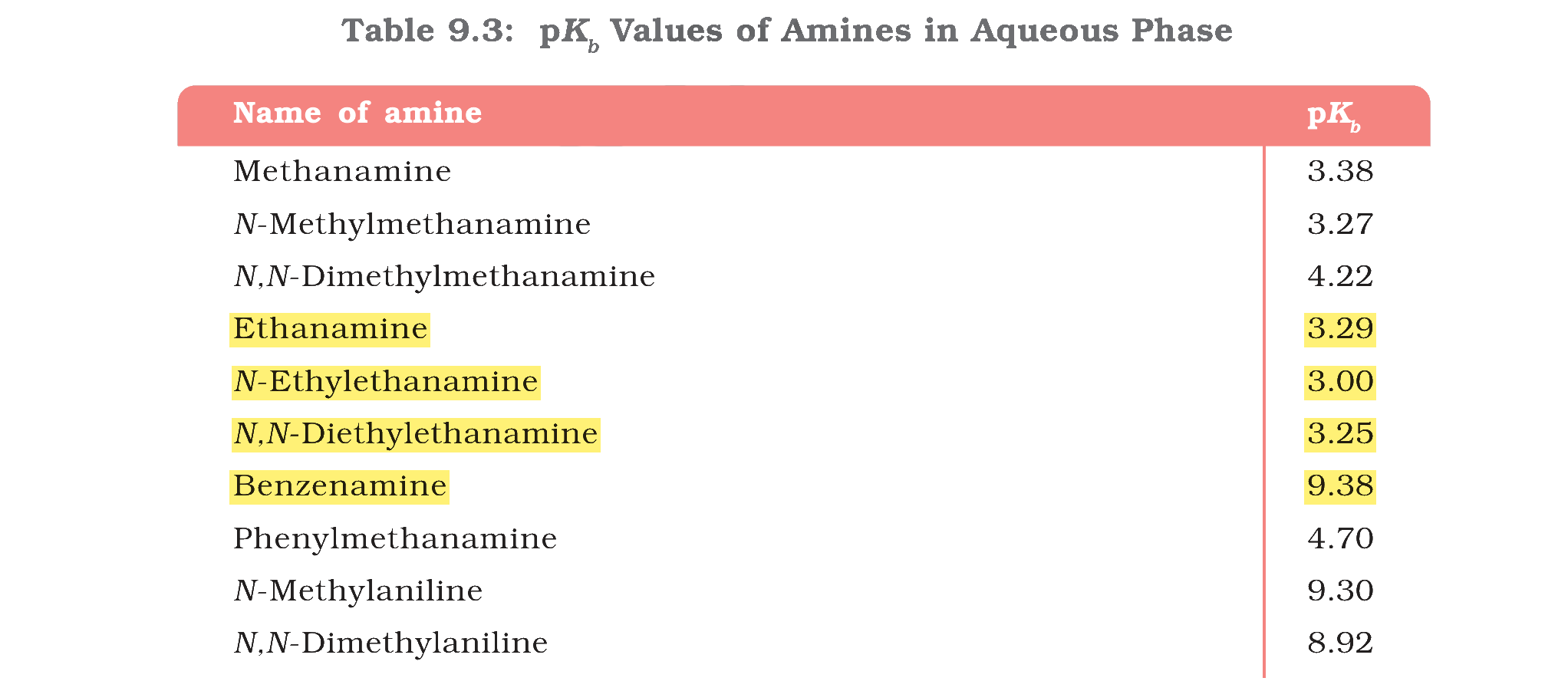
“… Thus, there is a subtle interplay of the inductive effect, solvation effect and steric hinderance of the alkyl group which decides the basic strength of alkyl amines in the aqueous state. The order of basic strength in case of methyl substituted amines and ethyl substituted amines in aqueous solution is as follows:
\( \displaystyle \ce{(C2H5)2NH > (C2H5)3N > C2H5NH2 > NH3} \)”
(b) Arylamines versus ammonia – “… It is because in aniline or other arylamines, the -NH2 group is attached directly to the benzene ring. It results in the unshared electron pair on nitrogen atom to be in conjugation with the benzene ring and thus making it less available for protonation.”