In the halomethanes CH3–F, CH3–Cl, CH3–Br and CH3–I, which of the following increases steadily from the C–F bond to the C–I bond?
Answer & explanation
Correct answer: option 2
The correct answer is Option (2) → C–X bond length
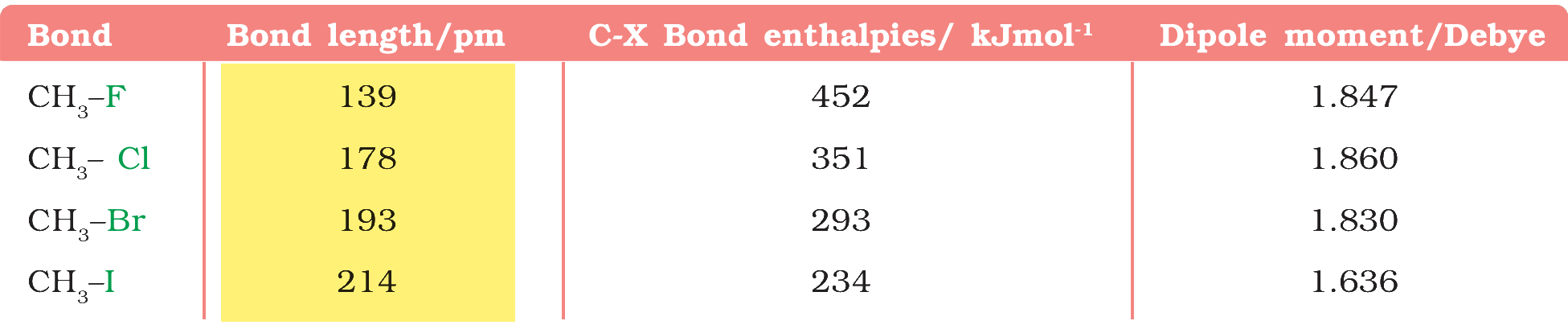
Going down group 17 from F to I, the size of the halogen atom increases. A bigger atom sits farther from the carbon nucleus, so the C–X bond gets longer: 139, 178, 193 and 214 pm.
Option (1) C–X bond enthalpy — Incorrect. A longer bond is a weaker bond, so the bond enthalpy falls, from 452 kJ mol−1 for C–F to 234 kJ mol−1 for C–I.
Option (3) Dipole moment — Incorrect. It does not change steadily: it rises slightly from CH3F (1.847 D) to CH3Cl (1.860 D) and then falls to 1.636 D for CH3I.
Option (4) Electronegativity of the halogen atom — Incorrect. Electronegativity decreases down the group; fluorine is the most electronegative halogen.
NCERT (2026-27 edition):
6.3 Nature of C-X Bond – “As we go down the group in the periodic table, the size of halogen atom increases. Fluorine atom is the smallest and iodine atom is the largest. Consequently the carbon-halogen bond length also increases from C—F to C—I. Some typical bond lengths, bond enthalpies and dipole moments are given in Table 6.2.”
Table 6.2: Carbon-Halogen (C—X) Bond Lengths, Bond Enthalpies and Dipole Moments