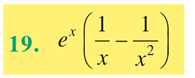
\(\int e^x\left(\displaystyle\frac{1}{x} - \frac{1}{x^2}\right)dx =\)
Answer & explanation
Correct answer: option 1
The correct answer is Option (1) → \(e^x \cdot \displaystyle\frac{1}{x} + C\)
By the standard result
\( \int e^x\left[f(x) + f'(x)\right]dx = e^x f(x) + C \)
With \(f(x) = \frac{1}{x}\):
\( \displaystyle f'(x) = -\frac{1}{x^2} \)
so the integrand is exactly \(e^x\left[f(x) + f'(x)\right]\), and
\( \displaystyle \int e^x\left(\frac{1}{x} - \frac{1}{x^2}\right)dx = e^x \cdot \frac{1}{x} + C \)
Shortcut: Differentiating Option (1) by the product rule gives \(e^x \cdot \frac{1}{x} + e^x \cdot \left(-\frac{1}{x^2}\right)\), which is the integrand.
NCERT (2026-27 edition):
Integration by Parts