
d-Block elements
The d-block of the periodic table contains the elements in which the d orbitals are progressively filled in each of the four long periods. The d-block elements are also known as transition metals. Originally, the name transition metals was derived from the fact their chemical properties were transitional between those of s- and p-block elements. They show numerous oxidation states. All the transition elements exhibit typical metallic properties such as high tensile strength, ductility, malleability, thermal and electrical conductivity. Another important property of transition metals is their catalytic activity. Transition metals generally have high melting and boiling points. Many d-block elements are colored.
Which of the following does not support the catalytic activity of transition metals?
Answer & explanation
Correct answer: option 4
The correct answer is Option (4) → Strengthening of the bonds in the reacting molecules
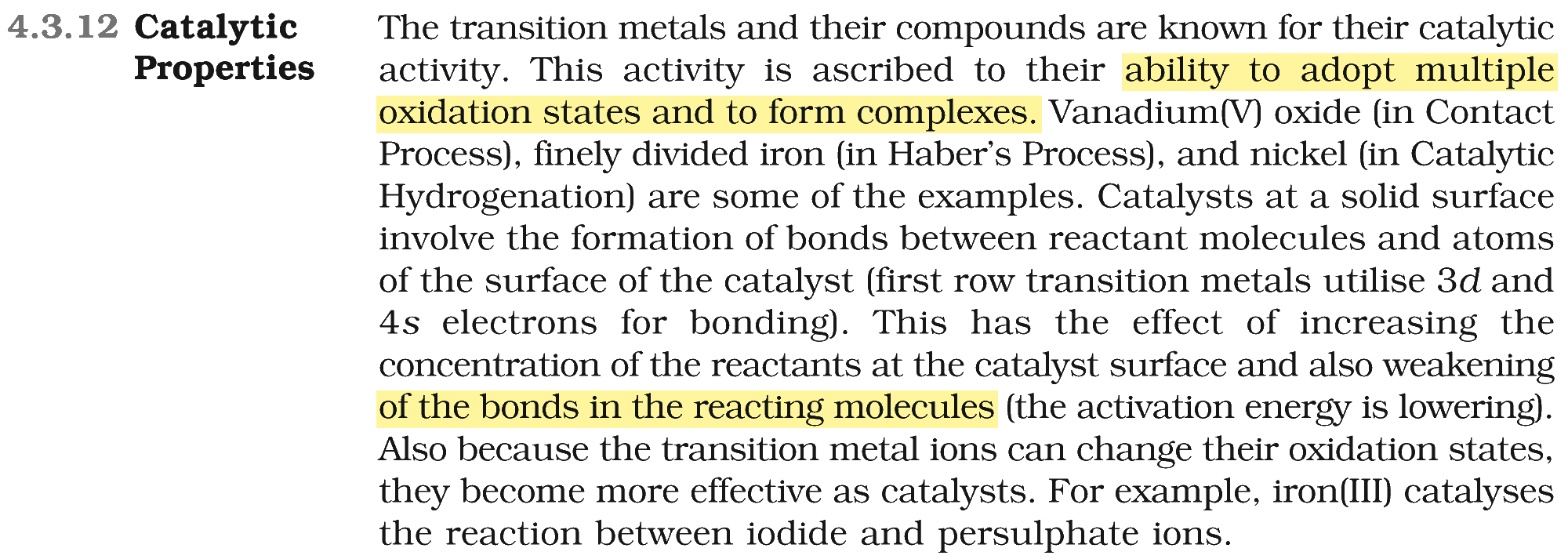
A transition metal catalyst weakens the bonds in the reacting molecules, which lowers the activation energy. “Strengthening of the bonds” is the opposite, so it does not support catalytic activity.
Option (1) Their ability to adopt multiple oxidation states and to form complexes. — Supports catalytic activity. The metal can change its oxidation state and so take part in electron transfer, and the reactants form temporary complexes with it.
Option (2) Formation of bonds between reactant molecules and atoms of the surface of the catalyst — Supports catalytic activity. These bonds increase the concentration of the reactants at the catalyst surface (first row metals use 3d and 4s electrons for this bonding).
Option (3) Lowering of the activation energy in reacting molecules — Supports catalytic activity. The new reaction path through the catalyst has a lower activation energy.
Option (4) Strengthening of the bonds in the reacting molecules — Does not support catalytic activity. The bonds are weakened, not strengthened.
NCERT (2026-27 edition):
Catalytic Properties
Note: The same/similar question has been asked in different years by NTA as per the details given below:
| 2026 | 2025 | 2024 | 2023 | 2022 |
|---|---|---|---|---|
| 31-05 S2 11-05 S1 | – | – | – | – |