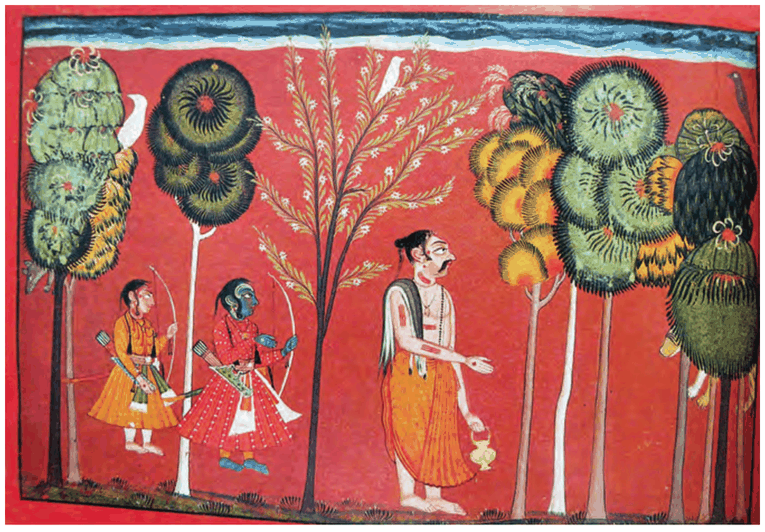
A Shangri Ramayana forest scene shows a wolf and tiger half hidden. Given below are two statements: one is labelled as Assertion (A) and the other is labelled as Reason (R).
Assertion (A): The fractional representation of the animals adds mystery to the work.
Reason (R): The fragmentary portrayal of the animals lends character to the forest as a thick, impenetrable jungle.
In the light of the above statements, choose the correct answer from the options given below:
Answer & explanation
Correct answer: option 2
The correct answer is Option (2) → Both (A) and (R) are true but (R) is NOT the correct explanation of (A).
Assertion (A): The fractional representation of the animals adds mystery to the work — True. The half-shown wolf and tiger make the scene mysterious.
Reason (R): The fragmentary portrayal of the animals lends character to the forest as a thick, impenetrable jungle — True. The hidden animals make the forest look dense and full of ferocious beasts.
Why R does not explain A? R names a different effect of the same portrayal: the forest looks like a dense jungle. A thick jungle alone does not make the work mysterious. The correct reason for A: the half-shown animals may be demons in disguise, and this possibility adds the mystery.
NCERT (2026-27): “Basohli School …Another painting from the same set depicts Rama and Lakshmana accompanying sage Vishvamitra to the forest to defeat the demons, who would distress the hermits by disturbing their meditative practices and contaminating their rituals. An interesting feature of this painting is the representation of animals, stealthily prowling behind trees, half hidden in the heavy outgrowth. A clever fragmentary portrayal of a wolf on the left and a tiger on the right by the artist not only lends character to the forest as a thick impenetrable jungle, populated with ferocious animals hiding everywhere, but also adds an emotive value to the painting regarding the extraordinary courage of the two young princes. The fractional representation of animals adds mystery to the work as there is a possibility of them being demons in disguise.”
“Rama and Lakshmana following sage Vishvamitra to the forest, Bala Kanda, Shangri Ramayana 1680–1688, Raja Raghbir Singh Collection, Shangri, Kullu Valley, India” |