
CUETMOCK
  • Pricing
  • Mentors
Log inStart freeStart free mocks→

First test, then trust

Try a free CUET mock test.

Join 5,00,000+ students who rehearsed exam day on the exact NTA screen before sitting CUET. On the web and on Android.

Start free mocks →Get the Android app
CUETMOCK

India's #1 CUET Mock Test Platform. Original NCERT-based questions on the exact NTA exam screen — trusted by 5,00,000+ students since CUET 2022.

Get it onGoogle PlayScan to download the CUETMOCK app

Mock tests

  • CUET mock test series
  • Commerce mocks
  • Humanities (Arts) mocks
  • Science mocks
  • Languages & GAT mocks
  • Free practice questions
  • Pricing

Resources

  • CUET exam guide
  • CUET syllabus
  • Universities accepting CUET
  • Expert blogs
  • News & notifications
  • Webinars & counselling
  • CUET score calculator
  • How we estimate your rank
  • FAQs

Company

  • About us
  • Our leadership & team
  • Our toppers
  • Mentors
  • For schools
  • Contact us
  • Terms
  • Privacy
  • Refund policy

Talk to us

+91 7696 6630 56info@cuetmock.comWhatsApp us

Our other platforms

  • JEE Mock — For IIT-JEE aspirants
  • NEET Mock — For NEET aspirants

Newsletter

Exam updates, study material and offers — no spam.

© 2026 NYC Ventures Pvt. Ltd.

701-702, Royal Business Park, Zirakpur, Punjab - 140603

  • Terms of use
  • Privacy policy
  • Refund policy
  • Contact us

iCUETMOCK is an independent preparation platform, not affiliated with the National Testing Agency (NTA). Always check exam details on the official NTA website.

  • Home
  • Mock tests
  • CUET guide
  • Pricing
  • Log in
Home/Practice questions/Physics
PhysicsSemiconductors and Electronic Devices

In the energy-band diagram of pure silicon at T = 0 K, the valence ba…

In the energy-band diagram of pure silicon at \(T = 0\) K, the valence band is full and the conduction band is empty. When the temperature is raised above 0 K, the diagram changes in such a way that

Answer & explanation+

Correct answer: option 2

The correct answer is Option (2) → a few electrons move into the conduction band and leave an equal number of holes in the valence band

At \(T = 0\) K a pure semiconductor behaves like an insulator. Above 0 K, thermal energy lifts some electrons across the gap into the conduction band. Each electron that leaves the valence band leaves an empty level there, which is a hole.

Option (1) all the electrons of the valence band move into the conduction band — Incorrect. Thermal energy frees only a few electrons. The conduction band is only partly occupied.

Option (2) a few electrons move into the conduction band and leave an equal number of holes in the valence band — Correct. Every electron that crosses the gap leaves one hole behind. So the numbers of free electrons and holes stay equal.

Option (3) a few electrons move into the conduction band and leave a larger number of holes in the valence band — Incorrect. More holes than free electrons is the case of a p-type semiconductor, where acceptor atoms add extra holes. Pure silicon has no such atoms.

Option (4) the energy gap disappears and the two bands overlap — Incorrect. The gap of silicon (about 1.1 eV) stays. Overlapping bands are found in metals.

NCERT (2026-27):
Intrinsic Semiconductor – “An intrinsic semiconductor will behave like an insulator at T = 0 K as shown in Fig. 14.6(a). It is the thermal energy at higher temperatures (T > 0K), which excites some electrons from the valence band to the conduction band. These thermally excited electrons at T > 0 K, partially occupy the conduction band. Therefore, the energy-band diagram of an intrinsic semiconductor will be as shown in Fig. 14.6(b). Here, some electrons are shown in the conduction band. These have come from the valence band leaving equal number of holes there.”
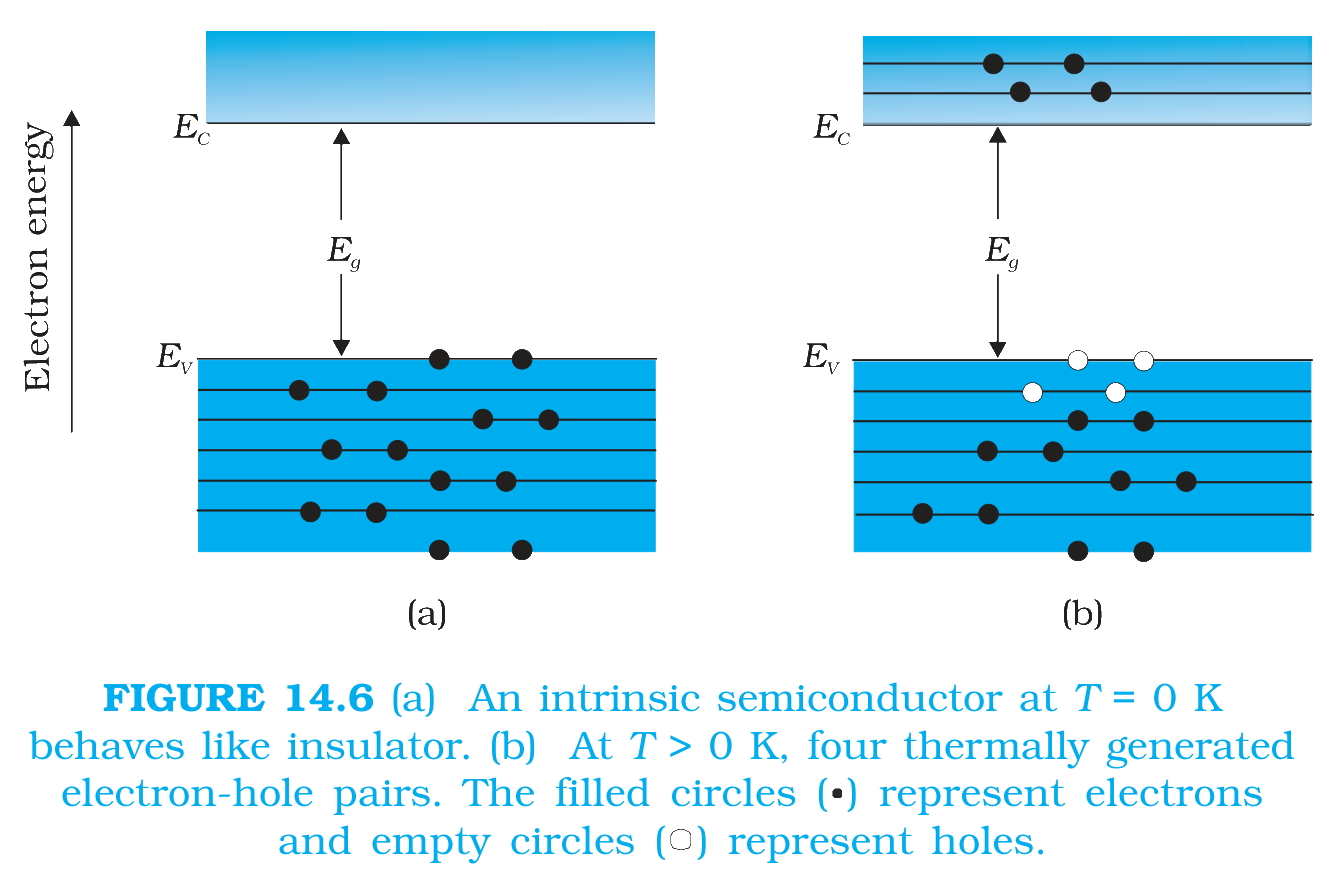
Fig. 14.6 An intrinsic semiconductor at T = 0 K and at T greater than 0 K

Advertisement

Practise more on Semiconductors and Electronic Devices

Chapter-wise mocks on the real NTA exam screen, with solutions and your rank. Your first mocks are free.

Start free mocks →

Advertisement

Next questions

  1. Observe the image and answer the following question.Who painted the Company painting in the image?Fine Arts · The Bengal School and Cultural Nationalism
  2. Which of the following structural isomers of C5H11Br is a tertiary (3°) bromide?Chemistry · Organic: Haloalkanes and Haloarenes
  3. Which of the following chemical tests can be used to distinguish between aniline and benzylamine?Chemistry · Organic: Amines
  4. Teak, sal and shisham are typical trees of which type of natural vegetation in India?General Aptitude Test · General Knowledge
  5. Which of the following countries has the longest coastline in the world?General Aptitude Test · General Knowledge
  6. The value of […] isMaths. Section B1 · Determinants
  7. Which letter will replace the question mark (?) in the following series? K, Q, V, ?, C, E, FGeneral Aptitude Test · Verbal Reasoning
  8. Fill in the blank with the most appropriate word from the given options:Ma needed six eggs for the cake, but the corner shop did not have _…English · Grammar: Pronoun
  9. If the plant is infected with virus, which part of the plant can be used to obtain virus-free plants?Biology · Biotechnology and its Applications
  10. पूरे शिक्षा तंत्र को कितने भागों में बांटा गया है?Hindi · अपठित गद्यांश (Comprehension - Prose)