
Which of the following chemical tests can be used to distinguish between aniline and benzylamine?
Answer & explanation
Correct answer: option 3
The correct answer is Option (3) → Coupling Reaction or Azo Dye Test
Aniline (\( \ce{C6H5NH2} \)) and benzylamine (\( \ce{C6H5CH2NH2} \)) are both primary amines, so tests for primary amines do not separate them. The difference is that in aniline the –\( \ce{NH2} \) group is on the ring (aromatic amine), while in benzylamine it is on a CH2 group (aliphatic amine).
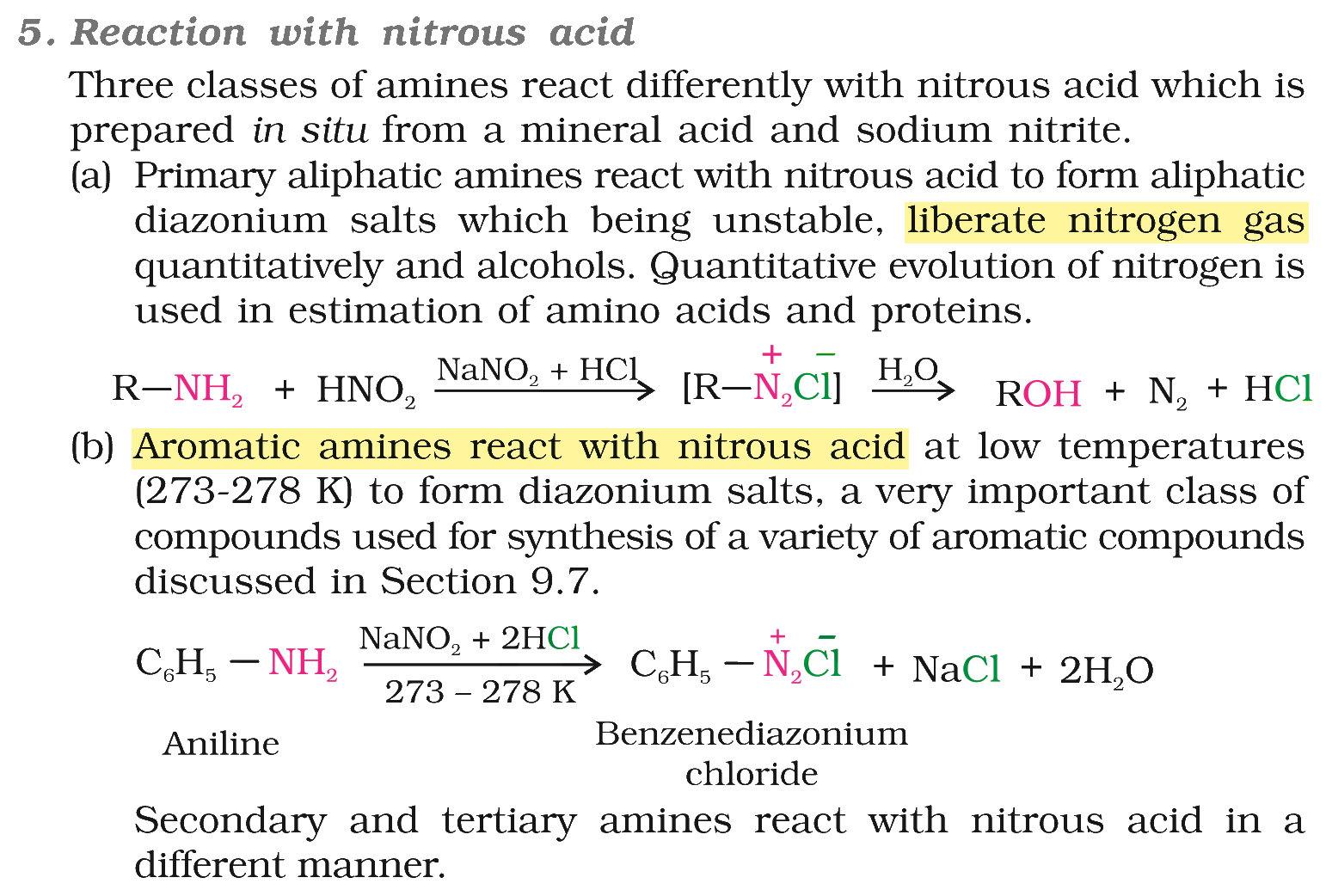
This decides what happens with nitrous acid (\( \ce{NaNO2} \) + HCl) at 273–278 K:
Aniline forms a stable benzenediazonium salt, which couples with β-naphthol in alkaline solution to give an orange-red azo dye.
\( \displaystyle \ce{C6H5NH2} \xrightarrow{\ce{NaNO2}/\ce{HCl},\ 273-278\ \mathrm{K}} \ce{C6H5N2^+Cl^-} \xrightarrow{\text{2-naphthol, }\ce{NaOH}} \text{orange-red dye} \)
Benzylamine forms an unstable aliphatic diazonium salt, which decomposes at once with brisk evolution of N2 gas and gives an alcohol; no dye is formed.
\( \displaystyle \ce{C6H5CH2NH2 + HNO2 -> C6H5CH2OH + N2 ^ + H2O} \)
So aniline and benzylamine are distinguished by the coupling reaction (azo dye test).
Why the other options are incorrect
Option (1) Isocyanide Test — Incorrect. It is given by all primary amines, aliphatic and aromatic, so both give the foul smell of an isocyanide.
Option (2) Hinsberg's Test — Incorrect. Both are primary amines, so both give sulphonamides that dissolve in alkali.
Option (4) Iodoform Test — Incorrect. Neither compound has a \( \ce{CH3CO} \)– or \( \ce{CH3CH(OH)} \)– group, so neither gives it.
NCERT (2026-27 edition):
Reaction with Nitrous Acid
Reactions Involving Retention of Diazo Group – “… Benzene diazonium chloride reacts with phenol in which the phenol molecule at its para position is coupled with the diazonium salt to form p-hydroxyazobenzene. This type of reaction is known as coupling reaction. …”