Read the passage and answer the questions:
The Urban Planning of a Civilisation
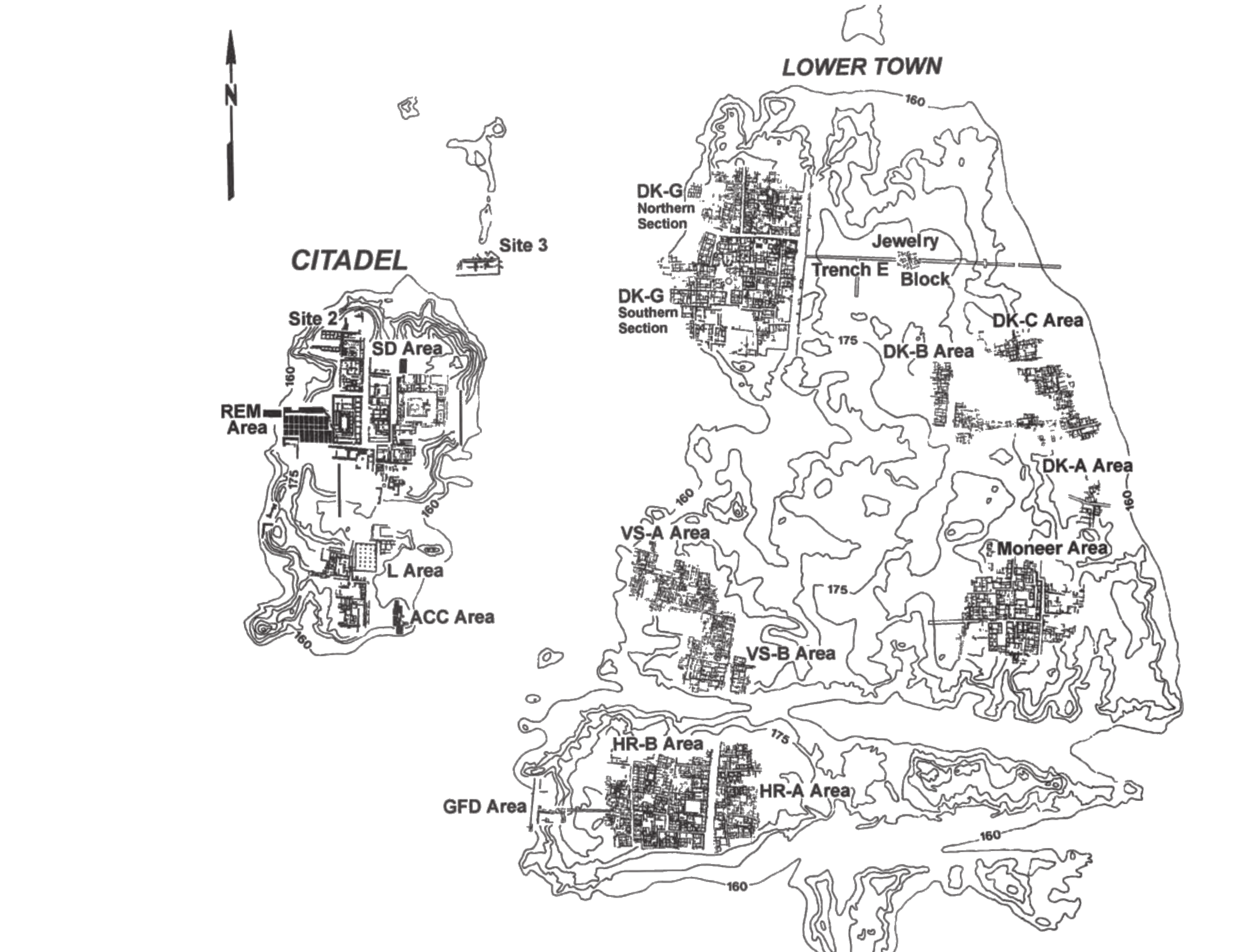
Perhaps the most unique feature of the Harappan civilisation was the development of urban centres. Let us look at one such centre, Mohenjodaro, more closely. Although Mohenjodaro is the most well-known site, the first site to be discovered was Harappa. The settlement is divided into two sections, one smaller but higher and the other much larger but lower. Archaeologists designate these as the Citadel and the Lower Town respectively. The Citadel owes its height to the fact that buildings were constructed on mud brick platforms. It was walled, which meant that it was physically separated from the Lower Town. The Lower Town was also walled. Several buildings were built on platforms, which served as foundations. It has been calculated that if one labourer moved roughly a cubic metre of earth daily, just to put the foundations in place it would have required four million person-days, in other words, mobilising labour on a very large scale. Consider something else. Once the platforms were in place, all building activity within the city was restricted to a fixed area on the platforms. So it seems that the settlement was first planned and then implemented accordingly. Other signs of planning include bricks, which, whether sun-dried or baked, were of a standardised ratio, where the length and breadth were four times and twice the height respectively. Such bricks were used at all Harappan settlements. Although Harappa was the first site to be discovered, it was badly destroyed by brick robbers. As early as 1875, Alexander Cunningham, the first Director-General of the Archaeological Survey of India (ASI), noted that the amount of brick taken from the ancient site was enough to lay bricks for “about 100 miles” of the railway line between Lahore and Multan.
Identify the correct statements from below:
(A) The settlement is divided into two sections.
(B) The Citadel owes its height to the fact that buildings were constructed on stone brick platforms.
(C) The lower town was also walled.
(D) In the Lower town, roads and streets were laid out along an approximate “grid” pattern, intersecting at right angles.
Choose the correct answer from the options given below:
Answer & explanation
Correct answer: option 2
The correct answer is Option (2) → (A), (C) and (D) only
(A) The settlement is divided into two sections. Correct. Mohenjodaro was divided into two sections: a smaller but higher one, the Citadel, and a much larger but lower one, the Lower Town.
(B) The Citadel owes its height to the fact that buildings were constructed on stone brick platforms. Incorrect. The Citadel’s buildings stood on mud brick platforms, not stone brick ones. The passage itself says ‘mud brick’; NTA changed one word in the statement.
(C) The lower town was also walled. Correct. The Citadel was walled off from the Lower Town, and the Lower Town was also walled.
(D) In the Lower town, roads and streets were laid out along an approximate “grid” pattern, intersecting at right angles. Correct. In the Lower Town, roads and streets were laid out along an approximate grid pattern, intersecting at right angles. It seems that streets with drains were laid out first and houses built along them.
NCERT (2025-26): “3. Mohanjodaro A Planned Urban Centre … Perhaps the most unique feature of the Harappan civilisation was the development of urban centres. Let us look at one such centre, Mohenjodaro, more closely. Although Mohenjodaro is the most well-known site, the first site to be discovered was Harappa. The settlement is divided into two sections, one smaller but higher and the other much larger but… lower. Archaeologists designate these as the Citadel and the Lower Town respectively. The Citadel owes its height to the fact that buildings were constructed on mud brick platforms. It was walled, which meant that it was physically separated from the Lower Town. The Lower Town was also walled.… 3.1 Laying out drains … One of the most distinctive features of Harappan cities was the carefully planned drainage system. If you look at the plan of the Lower Town you will notice that roads and streets were laid out along an approximate ‘grid’ pattern, intersecting at right angles.…”
Fig. 1.7 Layout of Mohenjodaro |