
Which of the following is FALSE in relation to the basicity of amines in aqueous solution?
Answer & explanation
Correct answer: option 2
The correct answer is Option (2) → Methylamine is more basic than dimethylamine.
Amines are basic because the lone pair on nitrogen can accept a proton. In water, the basic strength of aliphatic amines comes from the +I effect of alkyl groups, the solvation of the protonated amine and steric hindrance acting together; aryl amines are much weaker because the lone pair is delocalised into the benzene ring.
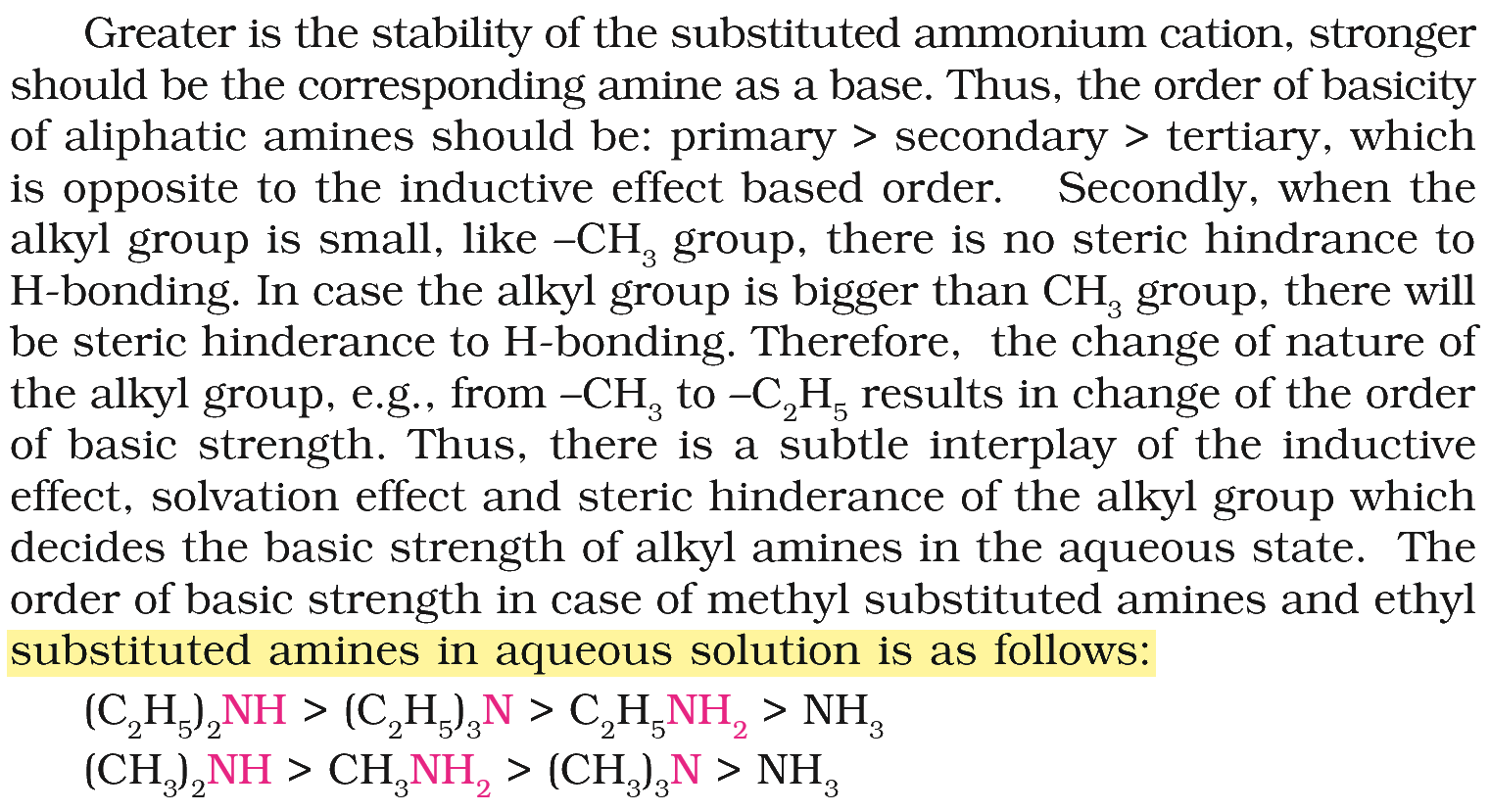
Option (1) Diethylamine is more basic than triethylamine. — True of basicity in water. \( \ce{(C2H5)2NH} \) (pKb 3.00) is more basic than \( \ce{(C2H5)3N} \) (pKb 3.25), because the tertiary amine is poorly solvated.
Option (2) Methylamine is more basic than dimethylamine. — False. Dimethylamine (pKb 3.27) is more basic than methylamine (pKb 3.38).
Option (3) Trimethylamine is more basic than ammonia. — True of basicity in water. \( \ce{(CH3)3N} \) (pKb 4.22) is more basic than \( \ce{NH3} \) (pKb 4.75), because of the +I effect of three methyl groups.
Option (4) Aniline is less basic than ammonia. — True of basicity in water. Aniline (pKb 9.38) is much weaker than \( \ce{NH3} \), because its lone pair is delocalised into the ring.
NCERT (2026-27 edition):
Alkanamines versus Ammonia – …
Arylamines versus Ammonia – “pKb value of aniline is quite high. … It is because in aniline or other arylamines, the –NH2 group is attached directly to the benzene ring. It results in the unshared electron pair on nitrogen atom to be in conjugation with the benzene ring and thus making it less available for protonation.”