Sex Determination
Read the following passage carefully and answer the given questions.
Grasshopper is an example of XO type of sex determination in which the males have only one X-chromosome besides the autosomes, whereas females have a pair of X-chromosomes. Sex determining mechanism in case of humans is XY type. A pair of X-chromosomes are present in the female, whereas the presence of an X and Y chromosome are determinant of the male characteristic. During spermatogenesis among males, two types of gametes are produced. 50 per cent of the total sperm produced carry the X-chromosome and the rest 50 per cent has Y-chromosome besides the autosomes. Females, however, produce only one type of ovum with an X-chromosome. There is an equal probability of fertilisation of the ovum with the sperm carrying either X or Y chromosome. The sex determination in honey bee is based on the number of sets of chromosomes which is an individual receives. An offspring formed from the union of a sperm and an egg develops as a female (queen or worker), and an unfertilised egg develops as a male (drone) by means of parthenogenesis.
Which one of the following pairs of chromosomes are found in female birds?
Answer & explanation
Correct answer: option 3
The correct answer is Option (3) → ZW-chromosomes
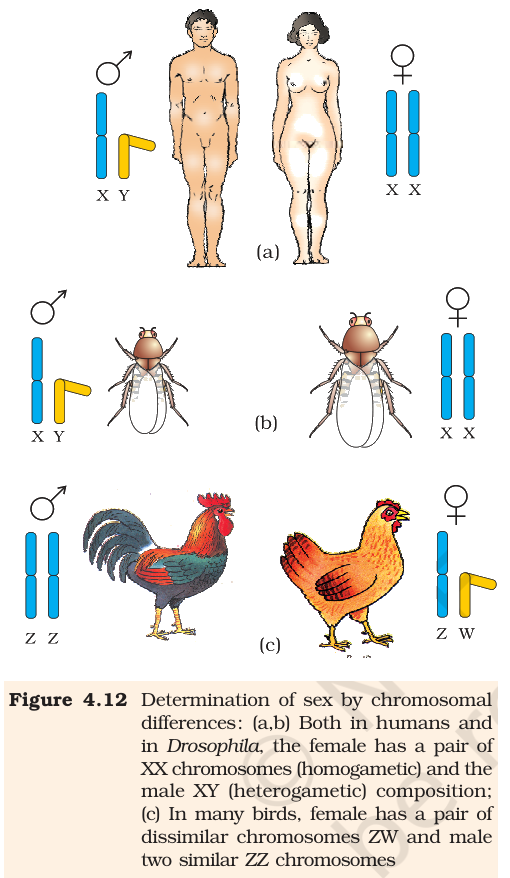
In birds, the number of chromosomes is the same in males and females, but the female makes two kinds of gametes. This is called female heterogamety. A female has one Z and one W, and a male has two Z chromosomes.
(1) XX-chromosomes — Incorrect. This is the pair of a human female. Birds use the symbols Z and W.
(2) ZZ-chromosomes — Incorrect. This is the pair of a male bird.
(3) ZW-chromosomes — Correct. This is the pair of a female bird.
(4) XY-chromosomes — Incorrect. This is the pair of a human male.
Note: The passage is taken from NCERT. NTA has put lines of the NCERT text together to make it. Most CUET (UG) questions come straight from NCERT, so study the book line by line, including figures and their titles.
NCERT Extract:
Sex Determination – “… In the above description you have studied about two types of sex determining mechanisms, i.e., XO type and XY type. But in both cases males produce two different types of gametes, (a) either with or without X-chromosome or (b) some gametes with X-chromosome and some with Y-chromosome. Such types of sex determination mechanism is designated to be the example of male heterogamety. In some other organisms, e.g., birds, a different mechanism of sex determination is observed (Figure 4.12 c). In this case the total number of chromosome is same in both males and females. But two different types of gametes in terms of the sex chromosomes, are produced by females, i.e., female heterogamety. In order to have a distinction with the mechanism of sex determination described earlier, the two different sex chromosomes of a female bird has been designated to be the Z and W chromosomes. In these organisms the females have one Z and one W chromosome, whereas males have a pair of Z-chromosomes besides the autosomes.”