
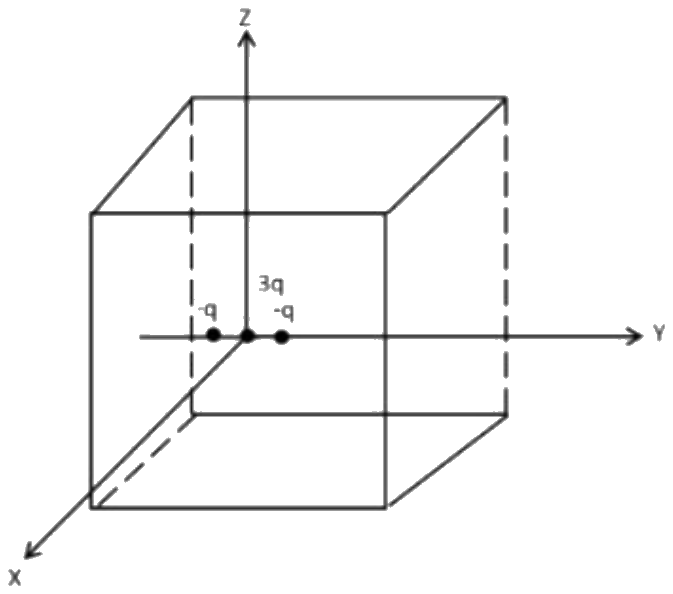
A cubical region of side \( a = 4 \) unit has its centre at the origin. It encloses three fixed point charges, \( -q \) at \( (0, -1, 0) \), \( +3q \) at \( (0, 0, 0) \) and \( -q \) at \( (0, +1, 0) \). Which one of the following statements is INCORRECT?
Answer & explanation
Correct answer: option 1
The correct answer is Option (1) → The net electric flux crossing the plane \( y = +2 \) is more than the net electric flux crossing the plane \( y = -2 \).
By Gauss’s law the net flux through the whole cube is \( q_{\mathrm{enc}}/\varepsilon_{0} \); the faces are at \( x, y, z = \pm2 \), and all three charges lie on the \( y \)-axis, placed symmetrically about the origin.
\( q_{\mathrm{enc}} = -q + 3q - q = +q \)
Option (1) The net electric flux crossing the plane \( y = +2 \) is more than the net electric flux crossing the plane \( y = -2 \). — Incorrect. The charges are symmetric under \( y \to -y \), so the planes \( y = \pm2 \) carry equal flux. This is the incorrect statement asked for.
Option (2) The net electric flux crossing the plane \( x = +2 \) is equal to the net electric flux crossing the plane \( x = -2 \). — Correct. Symmetry under \( x \to -x \).
Option (3) The net electric flux crossing the entire cubical region is \( \displaystyle\frac{q}{\varepsilon_{0}} \) — Correct. \( q_{\mathrm{enc}} = +q \).
Option (4) The net electric flux crossing the plane \( z = +2 \) is equal to the net electric flux crossing the plane \( z = -2 \). — Correct. Symmetry under \( z \to -z \).