Restriction endonucleases
Read the following passage carefully and answer the given question.
The cutting of DNA at specific locations became possible with the discovery of the so-called ‘molecular scissors’– (restriction enzymes). They cut DNA molecule at particular points by recognition a specific sequence of six base pairs. The piece of DNA was then linked with the plasmid DNA. These plasmid DNA act as vectors to transfer the piece of DNA attached to it. Each restriction endonuclease functions by ‘inspecting’ the length of a DNA sequence. Once it finds its specific recognition sequence, it will bind to the DNA and cut each of the two strands of the double helix at specific points in their sugar-phosphate backbones. Each restriction endonuclease recognizes a specific palindromic nucleotide sequences in the DNA. Palindromes are groups of letters that form the same words when read both forward and backward, e.g., “MALAYALAM”. As against a word-palindrome where the same word is read in both directions.
The first restriction endonuclease is -
Answer & explanation
Correct answer: option 2
The correct answer is Option (2) → Hind II
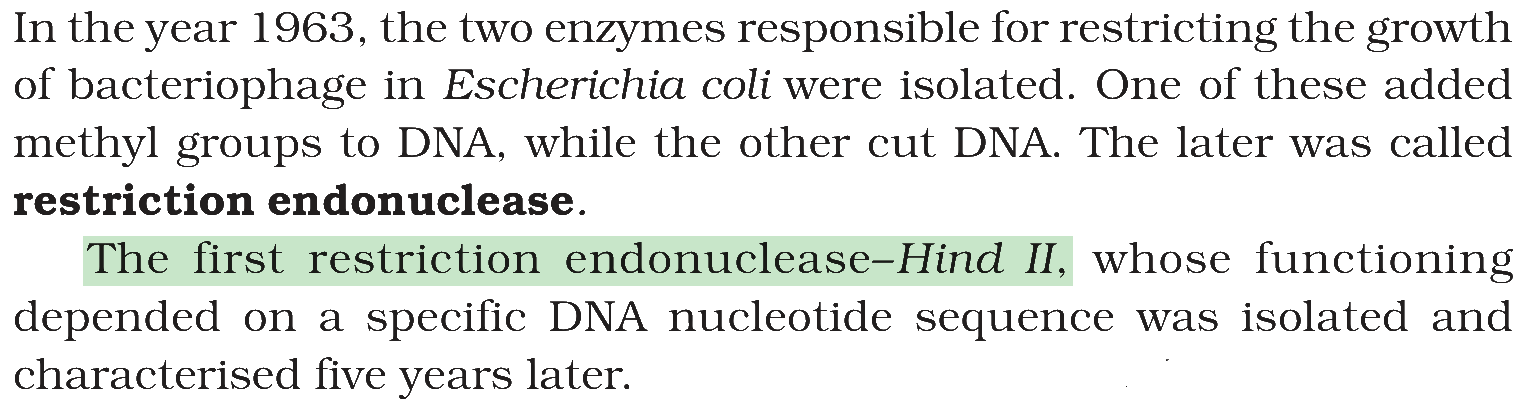
In 1963 two enzymes that restrict the growth of bacteriophage in Escherichia coli were isolated. One of them cut DNA and was called a restriction endonuclease. Five years later, the first restriction endonuclease whose working depended on a specific DNA sequence, Hind II, was isolated. It always cut DNA at a particular point by recognising a specific sequence of six base pairs.
(1) Hind III — Incorrect. It is a different enzyme from the same bacterium, Haemophilus influenzae, found later.
(2) Hind II — Correct. It was the first restriction endonuclease isolated.
(3) Eco RI — Incorrect. It comes from E. coli RY 13 and was found later. It recognises GAATTC.
(4) BamHI — Incorrect. It is another restriction enzyme, found later. It is often used to cut the vector pBR322.
Note 1: The passage is taken from NCERT. NTA has put lines of the NCERT text together to make it. Most CUET (UG) questions come straight from NCERT, so study the book line by line, including figures and their titles.
Note 2: A similar question was also asked in CUET (UG) 2026 on 21-05-2026 (Slot 1) and on 14-05-2026 (Slot 1), in CUET (UG) 2025 on 13-05-2025 (Slot 1), in CUET (UG) 2023 on 22-06-2023 (Slot 3), on 09-06-2023 (Slot 3) and on 01-06-2023 (Slot 3), and in CUET (UG) 2022 on 20-08-2022 (Slot 1).
NCERT Extract:
Restriction Enzymes –