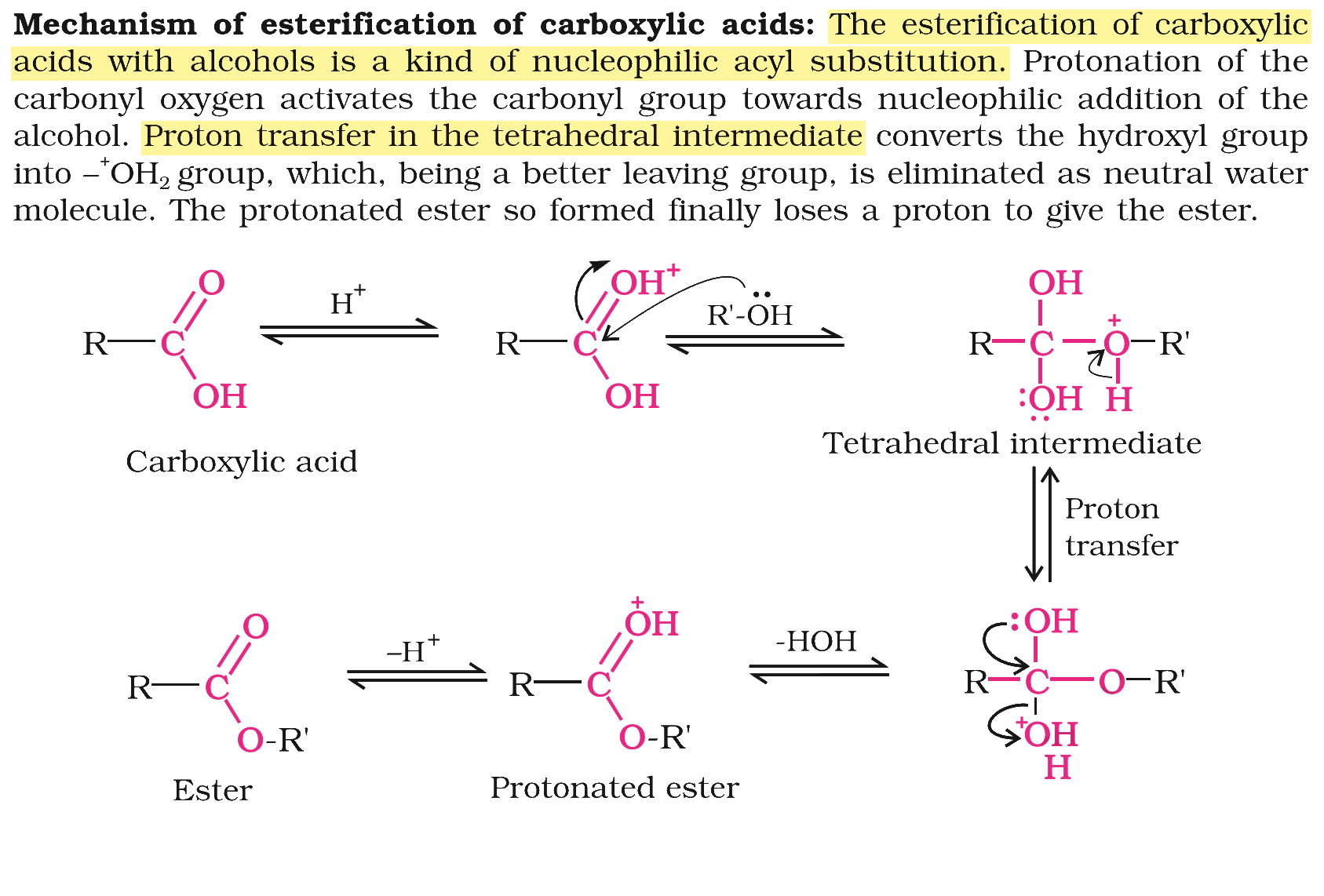
Acid-catalyzed esterification of carboxylic acids with alcohols proceeds through number of steps in a sequential manner. Choose the correct sequence of steps from the following:
A. Nucleophilic addition of alcohol on the protonated carbonyl in carboxylic acid
B. Elimination of a water molecule
C. De-protonation
D. Proton transfer in the tetrahedral intermediate, converting OH to +OH2.
Answer & explanation
Correct answer: option 3
The correct answer is Option (3) → A, D, B, C
Esterification is the reversible reaction of a carboxylic acid with an alcohol in the presence of a mineral acid (conc. \( \ce{H2SO4} \) or HCl gas):
\( \displaystyle \ce{RCOOH + R'OH} \xrightarrow{\ce{H+}} \ce{RCOOR' + H2O} \)
It is a nucleophilic acyl substitution. The acid first protonates the carbonyl oxygen (a step not listed in the question), which makes the carbonyl carbon more electrophilic. The listed steps then follow in this order:
(A) addition of the alcohol, giving a tetrahedral intermediate
(D) proton transfer, turning –OH into –\( \ce{^{+}OH2} \), a good leaving group
(B) loss of a water molecule, giving the protonated ester
(C) deprotonation, which releases the ester and returns \( \ce{H^{+}} \)
Shortcut: Deprotonation (C) must be the last step, because it gives the neutral ester and returns the catalyst. Only Option (3) ends with C.
NCERT (2026-27 edition):
Mechanism of Esterification of Carboxylic Acids