Rate law
Rate law is the expression in which reaction rate is given in terms of molar concentration of reactants, with each term raised to some power, which may or may not be same as the stoichiometric coefficient of the reacting species in a balanced chemical equation. The sum of powers of the concentration of the reactants, in the rate law expression is called the order of that chemical reaction. The number of reacting species (atoms, ions, or molecules) taking part in an elementary reaction, which must collide simultaneously in order to bring about a chemical reaction, is called molecularity of a reaction.
A first order reaction is taking place at 30 degree celsius with a rate constant of ‘k’ , the rate constant of the same reaction at 40 degree celsius will be approximately
Answer & explanation
Correct answer: option 3
The correct answer is Option (3) → 2k
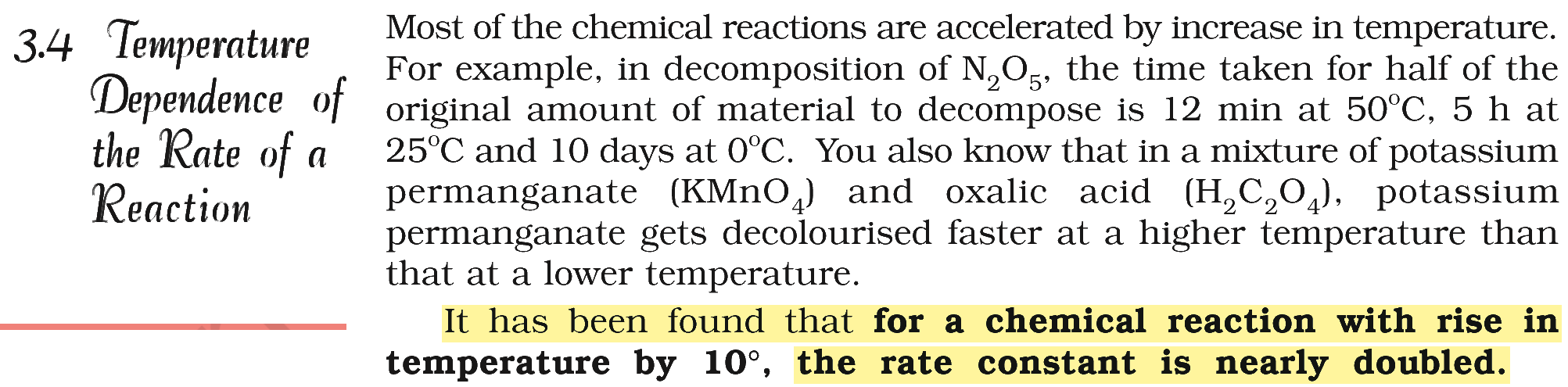
The rate of most chemical reactions increases with temperature. It is found that for a chemical reaction, a rise of 10 degrees in temperature nearly doubles the rate constant. The ratio of the rate constants 10 degrees apart is called the temperature coefficient:
\( \displaystyle \text{Temperature coefficient}=\frac{k_{T+10}}{k_{T}}\approx2\ \text{to}\ 3 \)
This follows from the Arrhenius equation, k = A e−Ea/RT: a small rise in temperature greatly increases the fraction of molecules with energy equal to or above the activation energy.
Here the temperature rises from 30 °C to 40 °C, a rise of 10 degrees:
\( \displaystyle k_{40}\approx2\times k_{30}=2k \)
Why the other options are incorrect
Option (1) k — Incorrect. The rate constant is not constant with temperature; it increases as the temperature rises.
Option (2) k + 10 — Incorrect. The rate constant changes by a factor, not by adding the temperature change, and 10 has no units matching k.
Option (4) 10k — Incorrect. A tenfold increase for a 10 degree rise is far larger than the usual factor of about 2.
NCERT (2026-27 edition):
Temperature Dependence of the Rate of a Reaction