
CUETMOCK
  • Pricing
  • Mentors
Log inStart freeStart free mocks→

First test, then trust

Try a free CUET mock test.

Join 5,00,000+ students who rehearsed exam day on the exact NTA screen before sitting CUET. On the web and on Android.

Start free mocks →Get the Android app
CUETMOCK

India's #1 CUET Mock Test Platform. Original NCERT-based questions on the exact NTA exam screen — trusted by 5,00,000+ students since CUET 2022.

Get it onGoogle PlayScan to download the CUETMOCK app

Mock tests

  • CUET mock test series
  • Commerce mocks
  • Humanities (Arts) mocks
  • Science mocks
  • Languages & GAT mocks
  • Free practice questions
  • Pricing

Resources

  • CUET exam guide
  • CUET syllabus
  • Universities accepting CUET
  • Expert blogs
  • News & notifications
  • Webinars & counselling
  • CUET score calculator
  • How we estimate your rank
  • FAQs

Company

  • About us
  • Our leadership & team
  • Our toppers
  • Mentors
  • For schools
  • Contact us
  • Terms
  • Privacy
  • Refund policy

Talk to us

+91 7696 6630 56info@cuetmock.comWhatsApp us

Our other platforms

  • JEE Mock — For IIT-JEE aspirants
  • NEET Mock — For NEET aspirants

Newsletter

Exam updates, study material and offers — no spam.

© 2026 NYC Ventures Pvt. Ltd.

701-702, Royal Business Park, Zirakpur, Punjab - 140603

  • Terms of use
  • Privacy policy
  • Refund policy
  • Contact us

iCUETMOCK is an independent preparation platform, not affiliated with the National Testing Agency (NTA). Always check exam details on the official NTA website.

  • Home
  • Mock tests
  • CUET guide
  • Pricing
  • Log in
Home/Practice questions/Chemistry
ChemistryOrganic: Alcohols, Phenols and Ethers

What is the structure of compound B?

Phenol

Aniline reacts with nitrous acid at 273- 278 K followed by treating with dilute acid gives a compound A. Compound A reacted with bromine water gives a Compound B as a white precipitate. Compound A reacts with Zinc dust to give compound C. Compound C reacts with Cl2 in the presence of Lewis acid to give compound D. Further, Compound A undergoes oxidation with chromic acid to give compound E.

What is the structure of compound B?

Answer & explanation+

Correct answer: option 3

The correct answer is Option (3) → 2,4,6-tribromophenol

The passage describes a chain of reactions that starts from aniline. Each step, with its full equation:

  • A (phenol): aniline is diazotised with nitrous acid (from NaNO2 + HCl) at 273–278 K, and the diazonium salt is hydrolysed by warming with dilute acid.

        \( \displaystyle \ce{C6H5NH2 + NaNO2 + 2HCl} \xrightarrow{\text{273-278 K}} \ce{C6H5N2^+Cl^- + NaCl + 2H2O} \)

        \( \displaystyle \ce{C6H5N2^+Cl^- + H2O} \xrightarrow{\text{warm, dil. acid}} \ce{C6H5OH + N2 ^ + HCl} \)

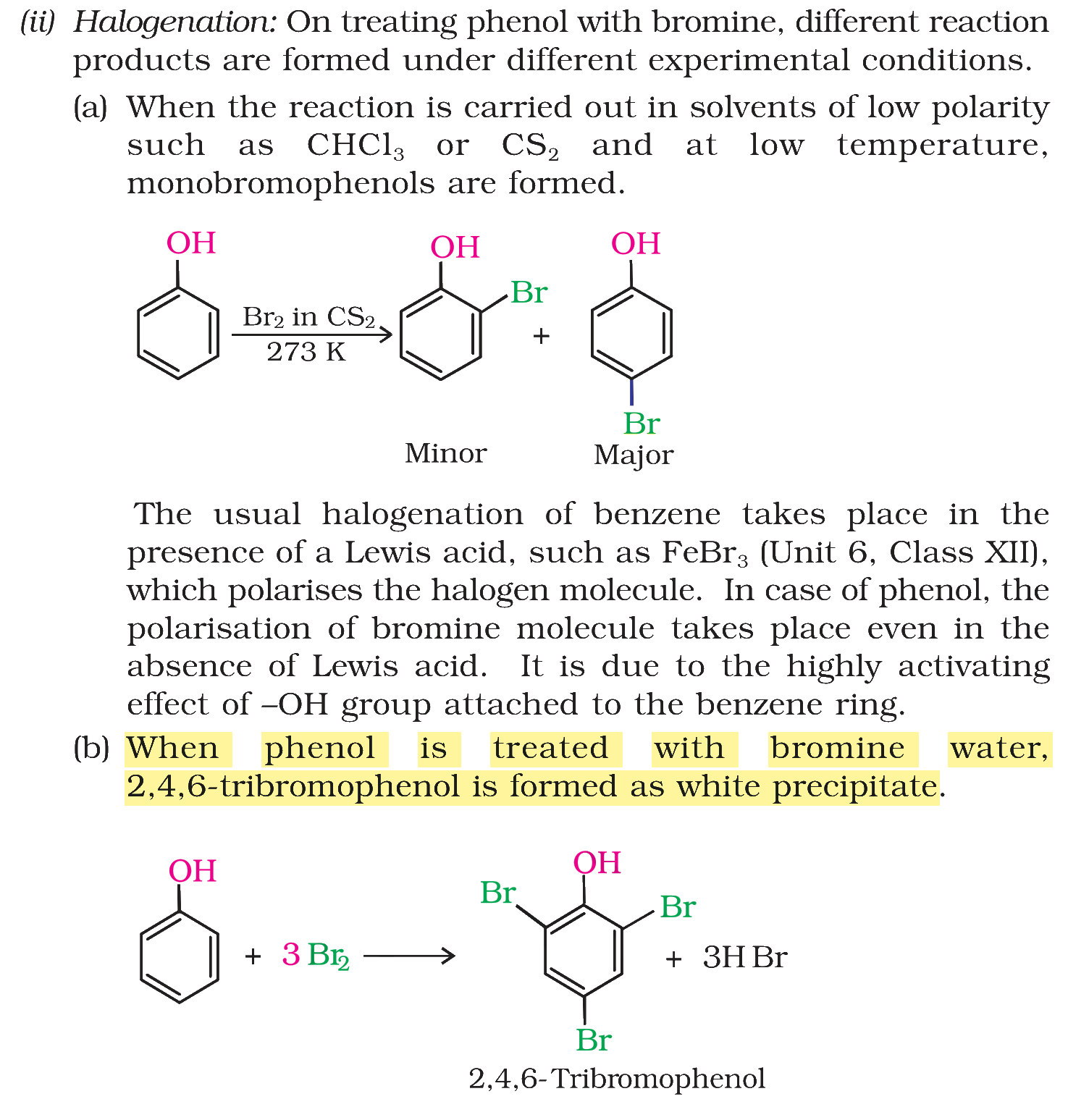
  • B (2,4,6-tribromophenol): phenol with bromine water gives a white precipitate. In water, phenol partly ionises to the phenoxide ion, which strongly activates the ring, so all three ortho and para positions are brominated.

        \( \displaystyle \ce{C6H5OH + 3Br2} \xrightarrow{\ce{H2O}} \ce{C6H2Br3OH v + 3HBr} \)

  • C (benzene): phenol heated with zinc dust loses its oxygen.

        \( \displaystyle \ce{C6H5OH + Zn} \xrightarrow{\Delta} \ce{C6H6 + ZnO} \)

  • D (chlorobenzene): benzene with Cl2 and a Lewis acid undergoes electrophilic substitution.

        \( \displaystyle \ce{C6H6 + Cl2} \xrightarrow{\text{anhyd. }\ce{FeCl3}} \ce{C6H5Cl + HCl} \)

  • E (benzoquinone): phenol is oxidised by chromic acid to the conjugated diketone.

        \( \displaystyle \ce{C6H5OH + 2[O]} \xrightarrow{\ce{Na2Cr2O7}/\ce{H2SO4}} \underset{\text{benzoquinone}}{\ce{C6H4O2}} + \ce{H2O} \)

Why the other options are incorrect

  • Option (1) a mixture of 2-bromophenol and 4-bromophenol — Incorrect. This mixture forms when bromine is used in a non-polar solvent (\( \ce{CS2} \) or \( \ce{CHCl3} \)) at low temperature, not with bromine water.

  • Option (2) 3-bromophenol — Incorrect. The –OH group directs bromine to the ortho and para positions, not the meta position.

  • Option (4) 2,4-dibromophenol — Incorrect. In bromine water, the third position is also brominated, so the product is the tribromo compound, not the dibromo one.

NCERT (2026-27 edition):
Halogenation
Textbook extract

Advertisement

Practise more on Organic: Alcohols, Phenols and Ethers

Chapter-wise mocks on the real NTA exam screen, with solutions and your rank. Your first mocks are free.

Start free mocks →

Advertisement

Next questions

  1. Match the LIST-I with LIST-II (Symbols have their usual meaning)LIST-ILIST-II(Physical Quantity)(Expression)A.Drift VelocityI. displaystyle…Physics · Current Electricity
  2. Which of the following poems composed in Sanskrit in 12th century is considered as the ‘Song of Cowherd’?General Aptitude Test · General Knowledge
  3. Match List-I with List-IIList-IList-IIDifferential equationOrder and degree(A) y'''+x^2(y'')^3+y=0 (I) 3, 2(B) y'''+y^2+e^y'=0 (II) 3, 3(C)…Applied Maths. Section B2 · Calculus
  4. Arrange the following component of a common size balance sheet as per schedule 3.A. Shareholder's fundsB. Non-current liabilitiesC. Current…Accountancy Part B · Analysis of Financial Statements
  5. Some strains of Bacillus thuringiensis produce proteins that can not kill:Biology · Biotechnology and its Applications
  6. The value of definite integral ∫_2^4displaystylex/(x^2+1) dx isApplied Maths. Section A · Definite Integration (Section A)
  7. Smog is caused by _______________.Geography · India-People and Economy: Geographical Perspective on selected issues and Problems
  8. Which part of the Constitution of India includes provisions for amending the Constitution?General Aptitude Test · General Knowledge
  9. In gel electrophoresis, DNA fragments move toward the anode due to:Biology · Biotechnology -Principles and Processes
  10. A, B, C are equal partners in a firm. C retired at the end of the year. Which of the following will not be received by the retiring partner?Accountancy Part A · Reconstitution of Partnership Firm: Retirement and Death