Rate of Chemical Reaction
Chemical reactions are the simplest way to convert one substance into the other substance. The feasibility of a chemical reaction is decided by the concepts of chemical thermodynamics under a defined set of conditions. The extent of a chemical reaction is determined by the principles of chemical equilibrium. But the information that remains undisclosed is the speed or rate of a chemical reaction, path or mechanism of a chemical reaction, time taken for a reaction to attain a state of equilibrium, factors controlling the rate of reaction etc. This information pertaining to the study of a chemical reaction is very pivotal, and it helps in understanding the nature (slow or fast nature) of a chemical reaction. The kinetics of a chemical reaction can be understood with the help of average rate of reaction or a differential rate law or an integrated rate law. There are various factors on which the rate of a chemical reaction depends viz. nature of reactants, temperature, catalyst, pressure and concentration of reactants and products (rate law expression).
What is the maximum possible value of molecularity for an elementary reaction?
Answer & explanation
Correct answer: option 2
The correct answer is Option (2) → 3
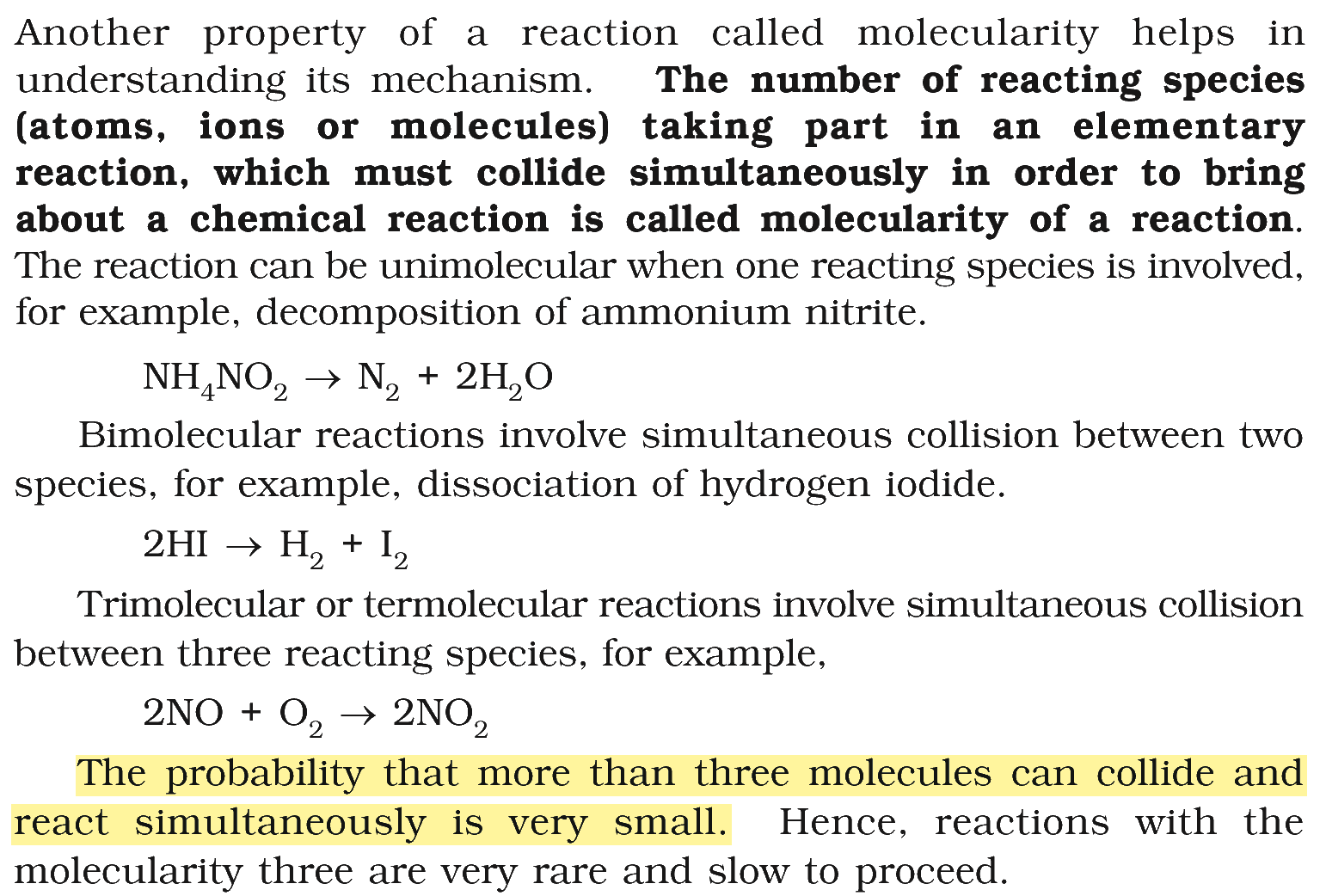
The chance of more than three species colliding at the same moment, with enough energy and the right orientation, is extremely small, so the maximum possible molecularity of an elementary reaction is 3.
NCERT (2026-27 edition):
Molecularity of a Reaction