
The angle of elevation of the top of a tower from a point is 30°. When the observer moves 50 meter closer, the angle becomes 60°. Find the height of the tower.
Answer & explanation
Correct answer: option 1
The correct answer is Option (1) → \(25\sqrt{3}\) meter
The tower AB and the ground make two right triangles, one seen from C (angle 30°) and one from D (angle 60°), 50 m nearer. In each, \(\tan\theta=\frac{\text{height}}{\text{distance from the foot}}\). Let the height be \(h\) and DB be \(x\).
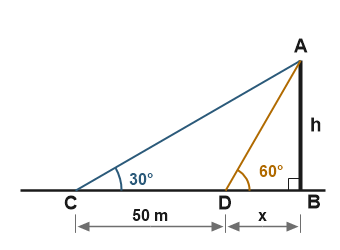
From D (angle 60°):
In the right triangle ADB: \(\tan60^\circ=\displaystyle\frac{h}{x}=\sqrt{3}\)
So the distance DB is \(x=\displaystyle\frac{h}{\sqrt{3}}\) (1)
From C (angle 30°, distance \(x+50\)):
In the right triangle ACB: \(\tan30^\circ=\displaystyle\frac{h}{x+50}=\frac{1}{\sqrt{3}}\)
So the distance CB is \(x+50=h\sqrt{3}\) (2)
Finding \(h\) (putting \(x\) from (1) into (2)):
The equation in \(h\) alone: \(\displaystyle\frac{h}{\sqrt{3}}+50=h\sqrt{3}\), which gives \(h+50\sqrt{3}=3h\)
Height of the tower: \(h=25\sqrt{3}\) m
Shortcut:
In triangle ACD, the outer angle at D is 60° and the angle at C is 30°, so the angle at A is \(60^\circ-30^\circ=30^\circ\)
Two equal angles make the triangle isosceles, so AD = CD = 50 m
Height: \(h=\text{AD}\times\sin60^\circ=50\times\frac{\sqrt{3}}{2}=25\sqrt{3}\) m