
Consider the following statements and choose the correct statements
(A) The bond angle 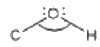 in methanol is slightly higher than the tetrahedral angle.
(B) The reaction of Grignard reagent with methanal produces a secondary alcohol.
(C) The boiling point of ethanol is higher than methoxymethane.
(D) Acetylation of Salicylic acid produces Aspirin.
Choose the correct statements from the options given below:
Answer & explanation
Correct answer: option 4
The correct answer is Option (4) → (C) and (D) only
In alcohols the oxygen of the –OH group is sp3 hybridised and carries two lone pairs. The polar O–H bond lets alcohol molecules form hydrogen bonds. These two facts decide the bond angle, the boiling points and much of the chemistry of alcohols.
(A) The bond angle C–O–H in methanol is slightly higher than the tetrahedral angle. — Incorrect. The C–O–H angle in methanol is 108.9°, slightly less than the tetrahedral angle (109°28′). The two lone pairs on oxygen repel the bond pairs more strongly than bond pairs repel each other, so the bonds are pushed a little closer.
(B) The reaction of Grignard reagent with methanal produces a secondary alcohol. — Incorrect. The R group of the Grignard reagent adds to the carbonyl carbon, and hydrolysis gives the alcohol. Methanal has two H atoms on its carbonyl carbon, so the product carbon carries only one R group: a primary alcohol. Other aldehydes give secondary alcohols and ketones give tertiary alcohols.
\( \displaystyle \ce{HCHO + RMgX -> R-CH2-OMgX} \xrightarrow{\ce{H2O}} \ce{R-CH2-OH + Mg(OH)X} \)
(C) The boiling point of ethanol is higher than methoxymethane. — Correct. Both compounds have the formula \( \ce{C2H6O} \) and the same molar mass. Ethanol molecules are held together by intermolecular hydrogen bonds through their O–H groups. Methoxymethane, \( \ce{CH3-O-CH3} \), has no O–H group, so its molecules cannot hydrogen bond with each other, and it boils at a much lower temperature.
(D) Acetylation of Salicylic acid produces Aspirin. — Correct. Acetylation is the introduction of an acetyl group (\( \ce{CH3CO} \)) in place of the H of an –OH group. The phenolic –OH of salicylic acid reacts with acetic anhydride in the presence of a little acid to give acetylsalicylic acid (aspirin):
\( \displaystyle \ce{HO-C6H4-COOH + (CH3CO)2O} \xrightarrow{\ce{H^+}} \ce{CH3COO-C6H4-COOH + CH3COOH} \)
NCERT (2026-27 edition):
Structures of Functional Groups

Preparation of Alcohols – “… You will notice that the reaction produces a primary alcohol with methanal, a secondary alcohol with other aldehydes and tertiary alcohol with ketones.”
Physical Properties – “It is interesting to note that boiling points of alcohols and phenols are higher in comparison to other classes of compounds, namely hydrocarbons, ethers, haloalkanes and haloarenes of comparable molecular masses. For example, ethanol and propane have comparable molecular masses but their boiling points differ widely. The boiling point of methoxymethane is intermediate of the two boiling points.
The high boiling points of alcohols are mainly due to the presence of intermolecular hydrogen bonding in them which is lacking in ethers and hydrocarbons.”
Chemical Reactions – “… The introduction of acetyl (CH3CO) group in alcohols or phenols is known as acetylation. Acetylation of salicylic acid produces aspirin.”